Liwer Chawa
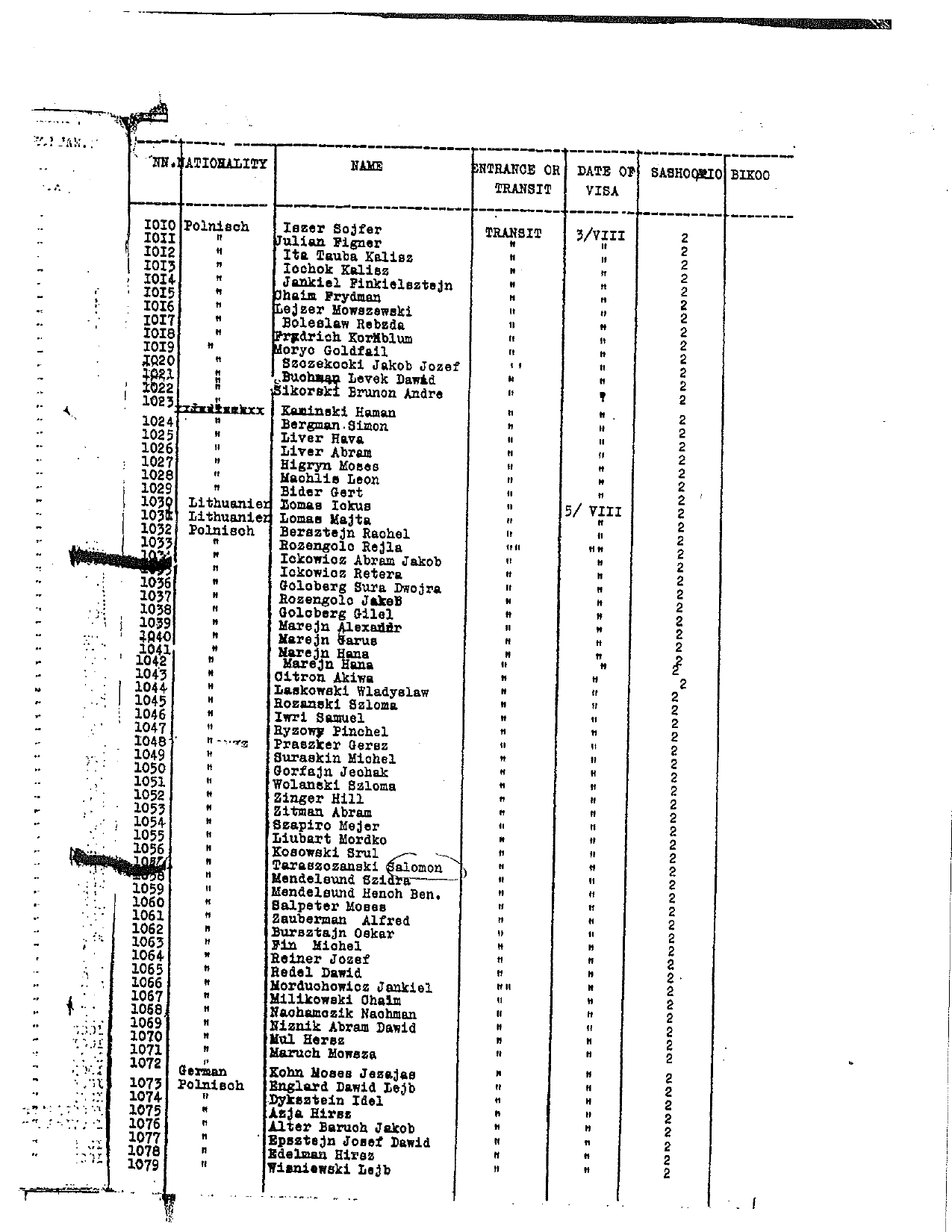
Liwer Chawa received transit visa no. 1025 at the Japanese consulate in Kaunas on 3 August 1940. Aged 48 in 1940.
What the register records
- Nationality as recorded
- Polnisch
- Age in 1940
- 48
- Family, per the Kitade-Bluman list
- wife of #1026, child Jochewet (19)
The journey
Reached Japan; aided by the Polish ambassador Tadeusz Romer; registered in Kobe for Canada.
Travelled with, and never given a number
- Jochewet — child, aged 18
The register recorded visa holders. It did not reliably record the wives and children who travelled on somebody else’s visa, so these people have no entry of their own and cannot be searched for. Where the archive has recovered a name, it is here.
What is known
Chawa Heller was born in Szydłowiec, Poland, on 1 November 1891. Because her birth was not registered until two years later, her date of birth was afterwards recorded wrongly. She had four sisters and three brothers, most of whom did not survive the war. Her marriage to Abraham Liwer was arranged, but the couple met in secret before the wedding; defying Orthodox tradition, she neither shaved her head nor wore a wig. After marrying she moved to Abraham's home town of Będzin. On 2 September 1939 she fled Będzin with her husband Abraham and their daughter Jadzia. Her son Jacob was studying in Belgium. Her granddaughter Arlette Liwer, who has written the family's account for this archive, tells what happened in Lwów in her own words: "They settled in Lwów, but their peace was short-lived. One day, Abraham ran into a former employee from his bicycle parts factory in Będzin. Under the Soviet regime, this recognition was dangerous. To the Bolsheviks, Abraham was no longer just a refugee; he was a bourgeois factory owner and a Zionist activist. Either identity could trigger an arrest. The next day, a Russian acquaintance warned him that his name was on a Soviet blacklist. While Chawa and Jadzia were safe from the immediate German threat, Abraham had to escape. He fled to Lithuania that same night. By November 1939, Soviet authorities declare the inhabitants of annexed eastern Poland, including Lwów, Soviet citizens by default. Many Jews accept Soviet citizenship, fearing deportation to Siberia. In June 1940, Chawa is forced to make a choice: Soviet citizenship or repatriation to German-occupied Poland: Hitler or Stalin. She can't consult Abraham. Relatives in Będzin write, urging her to come back, that things are better now. She fears that Jadzia and her could be trapped inside the Soviet Union, unable to follow Abraham, if he escapes from Lithuania. Chawa ticks the box for repatriation, unaware that the Soviet authorities never intended to repatriate Polish Jews. By applying to return home, refugees unwittingly reveal themselves as unwilling to submit to Soviet rule. Thousands of refugees opt to go back, never imagining the scale of German atrocities still to come. The consequences of Chawa's choice arrive almost immediately. A Soviet-wide NKVD deportation operation begins in the early hours of June 29, 1940. Their targets: those who refused Soviet citizenship. 78,000 people were transported to remote regions of the USSR; roughly 85 percent of those deported were Jewish (Andrew Zalewski and Tony Kahane, 'Lviv Under the Soviets (1939–1941): Students, Refugees and Deportees', Studies on National Movements, vol. 12, 2023, p. 121). Chawa and Jadzia are among them. It is ironically what saved them. The town they had asked to be returned to was Będzin, and what happened to the Jews of Będzin is set out on Abraham's page. Nothing of this kind is recorded of the Polish refugees who reached Lithuania. There the Soviet interest was in their dollars: exit permits were sold, and Intourist tickets to Vladivostok with them. The Intourist package included the ship to Tsuruga." — Arlette Liwer, granddaughter of Chawa and Abraham Liwer, September 2026. Chawa and her daughter Jadzia were taken on 29 or 30 June 1940, while Abraham was in Lithuania getting the visas, and sent to the labour camp at Krasnouralsk in the Urals. At Krasnouralsk, for nine months, they shared a cramped hut with other prisoners. Chawa, nearly fifty, was excused from labour; Jadzia did gruelling roadwork through the bitter winter. After fighting for three months at the NKVD office in Vladivostok, Abraham obtained special permission from the Soviets for Chawa and Jadzia to leave the camp and join him there. They were released in April 1941, and the family believes they were the first Polish Jewish prisoners freed from Siberian exile. Once in Japan, with the help of the Polish ambassador Tadeusz Romer, Chawa and Jadzia were given a joint Polish passport and Canadian visas. Jadzia spent seven weeks in Tokyo, from 5 May to 25 June 1941, as a volunteer at the Polish Embassy, sorting the letters that came from Polish prisoners in the Siberian camps. After a brief reunion the family was separated again: Abraham disembarked alone at Seattle while Chawa and Jadzia continued to Vancouver. It took Abraham two years to prevail in his battle with United States immigration, and twenty-five months passed before the family was permanently reunited. Chawa and Abraham settled in Albany, New York. After his death she moved to Queens. Her name appears in the records as Chawa, Chava and Hawcia; in America she took the name Eva. She died in 1976. Her daughter's name was Jochewet; she was called Jadzia, and in America she became Joan. This story was contributed by Arlette Liwer-Stuip, granddaughter of Abraham and Chawa Liwer.
Where this comes from
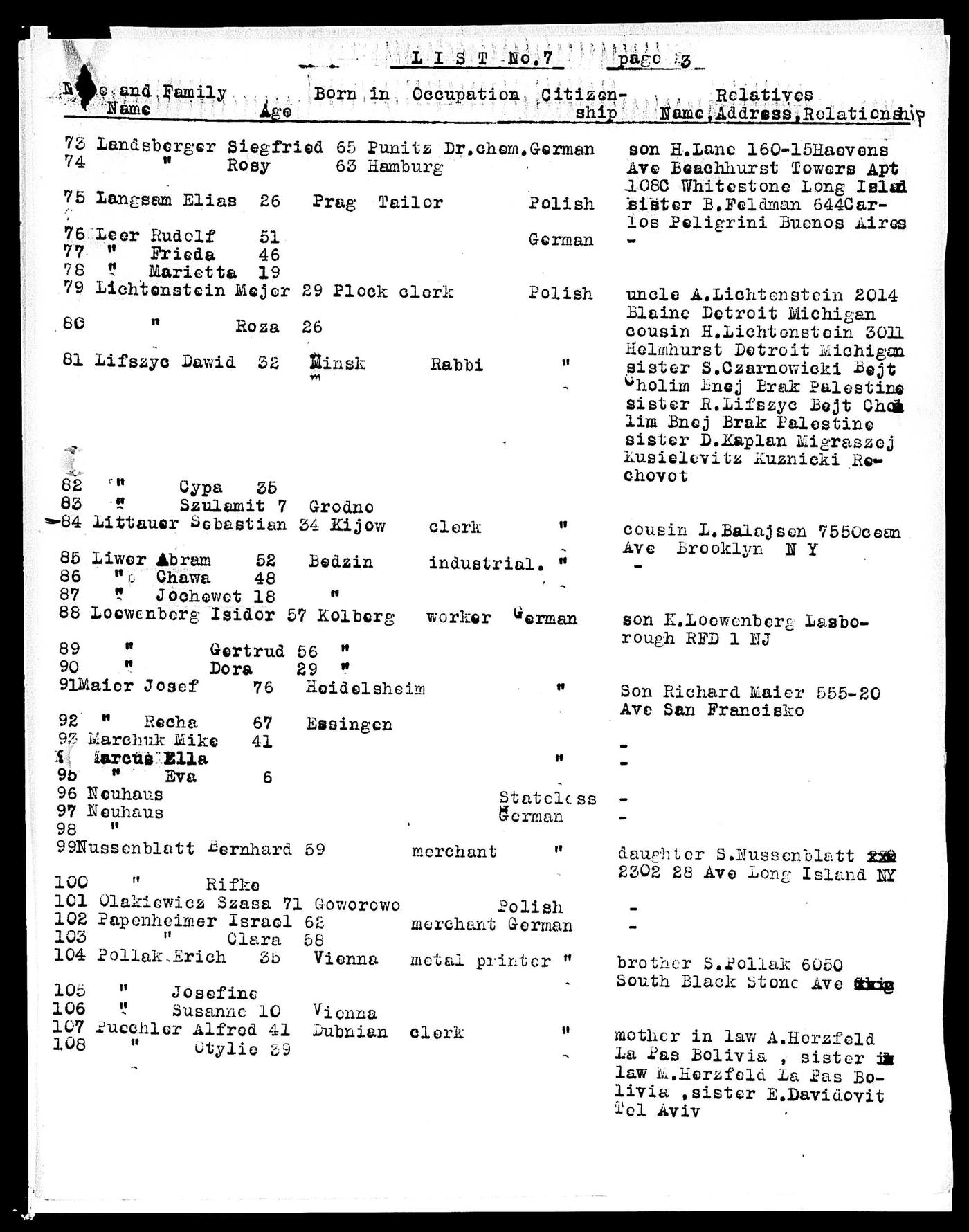
- The Kobe relatives list — refugees at Kobe in 1941 recorded with their relatives abroad. Seventy-six pages in numbered sheets (LIST No. 7, No. 16 and others), each line giving a name, age, birthplace, occupation and citizenship, and then…
Entry 86 of the Kobe community's list of refugees and their relatives abroad: aged 48. - David Rosen, 'Lithuania to Moscow to Yokohama to Seattle: Holocaust Escape via Japan', Mass-Pocha (Jewish Genealogical Society of Greater Boston), October 2022, pp. 17-21. Reproduces the United States arrival manifest of the M.S. Hie Mar…
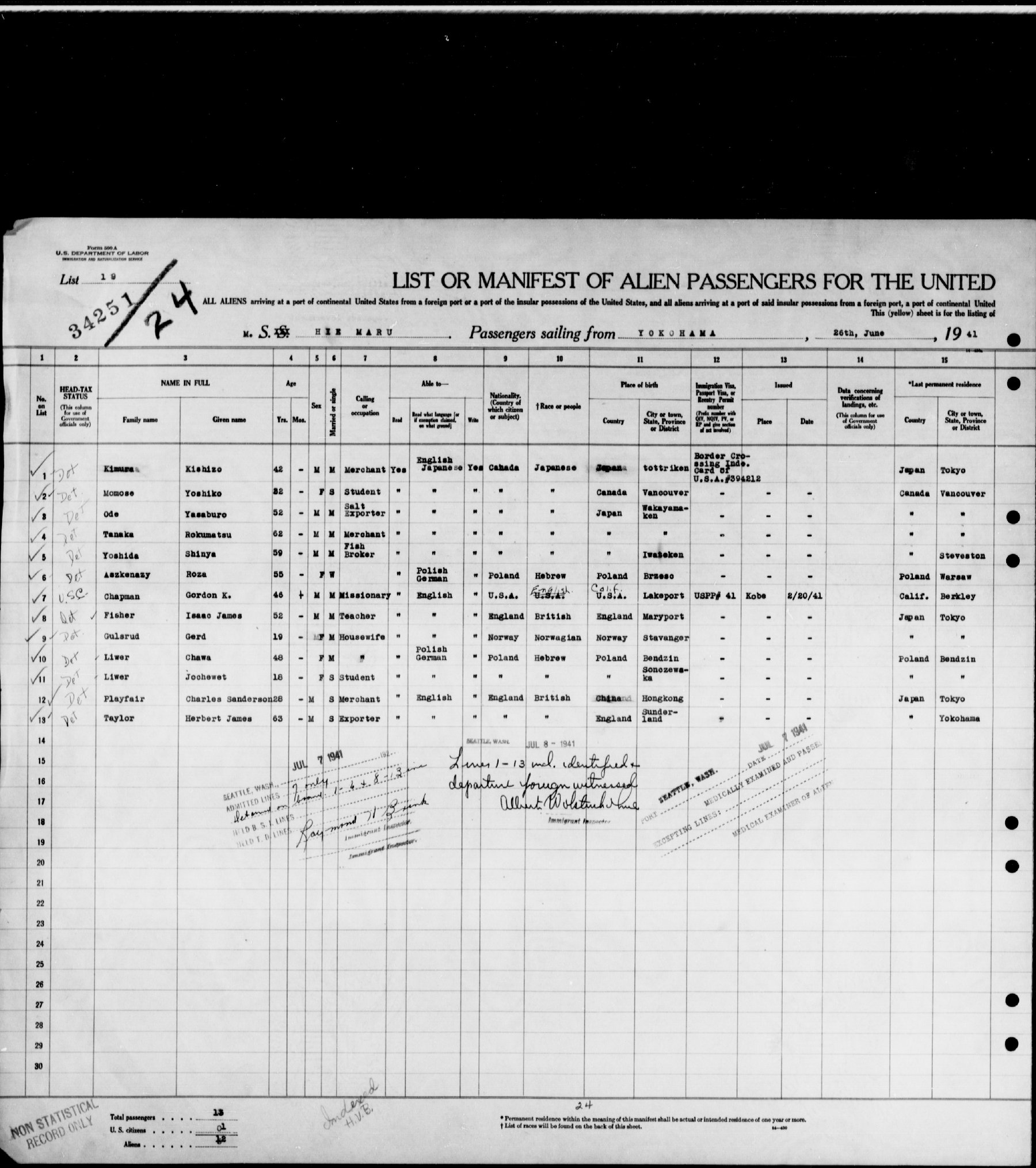
The article in which this manifest reaches the archive. David Rosen read the Liwer family's lines out of the original sheet himself - Chawa's and her daughter's among them - and he sent the article to the archive in August 2026. The questions it answers are Arlette Liwer-Stuip's, whose research prompted it. What the manifest itself records is set out below, under the sheet. - M.S. Hie Maru, Yokohama 26 June - Seattle 7 July 1941, continuing to Vancouver: the ship's last commercial crossing before she was taken for the Japanese Navy. Read from the manifest reproduced in David Rosen's Mass-Pocha article of Octo…
Lines 10 and 11 of the same sheet, and the reason this family is on two different pages of the archive. Chawa Liver, 48, and her daughter Jochewet, 18, a student - both Polish citizens, both marked 'Det'. They were detained aboard rather than landed, along with every other passenger on that page but one, and then continued to Vancouver: they held Canadian visas and he did not. Column 13 records passports issued at KOBE on 20 February 1941. Those were Polish passports obtained through Ambassador Tadeusz Romer, together with the Canadian visas, and mother and daughter shared a single joint passport because the Polish embassy in Japan had run out of blank forms. The sheet is stamped SEATTLE, WASH. JUL 7 1941 and certified the following day by Immigrant Inspector Albert Wolstenholme. The compiled register's note that this line went to Canada while No. 1026 went to the United States is exactly right, and this is the document that shows why. - List or Manifest of Alien Passengers for the United States - M.S. Hie Maru, which sailed from Kobe on 23 June and from Yokohama on 26 June 1941 and reached Seattle on 7 July 1941; list 19, the sheet stamped 34251/24, sailing from Yokoham…
Line 10 of the sheet. LIWER, CHAWA, 48, female, married; reads Polish and German and writes; Polish nationality, Hebrew; born at Będzin, last permanent residence Będzin; no United States visa in the visa column. The register has her as Liwer Chawa, 48, wife of No. 1026, going to Canada. The surname is spelt exactly as the register carries it, the given name is the same, the age is the same to the year, and the destination agrees: the ship went on from Seattle to Vancouver, and the inspectors' notes at the foot of the sheet record that she was detained on board at Seattle on 7 July 1941 and that her departure for a foreign port was witnessed the next day. The register's 'Canada' for her and 'USA' for her husband were compiled from a source that had nothing to do with this manifest, and both are what the manifest shows. - List or Manifest of Alien Passengers for the United States - M.S. Hie Maru, which sailed from Kobe on 23 June and from Yokohama on 26 June 1941 and reached Seattle on 7 July 1941; list 19, the sheet stamped 34251/24, sailing from Yokoham…
Line 11, immediately below her mother. LIWER, JOCHEWET, 18, female, single, student; Polish nationality, Hebrew; born in Poland, last permanent residence Będzin; detained on board with her mother and her departure for a foreign port witnessed the next day. The register names her: the entry for No. 1025 records a child, Jochewet, aged 19, which was her age in August 1940. The 18 on this manifest is the age her father gave for her, not her age: she was twenty, born on 4 December 1920 (Chawa's granddaughter Arlette Liwer, 14 September 2026). - Arlette Liwer-Stuip, account written for this archive of her grandfather ABRAM (AVRAM) LIWER, register No. 1026, and his wife CHAWA, No. 1025 — the flight from Będzin, the crossing into Lithuania, the Curaçao declaration from Jan Zwarten…
Her granddaughter's written account of the flight from Będzin, the Curaçao declaration and the Sugihara visas, the deportation to Siberia, and the reunion in New York. Given by Arlette Liwer. - stuip-2026-08-04: The Liwers for Chaim's site — a document sent to the archive by a correspondent. Abraham Liwer, born in Będzin, Poland, 1892. On Chiune Sugihara’s official list – No. 1026
Also known as / spellings: Abram Liver Polish .…
Her granddaughter's written account of the flight from Będzin, the Curaçao declaration and the Sugihara visas, the deportation to Siberia, and the reunion in New York. Given by Arlette Liwer. - David Rosen, 'Lithuania to Moscow to Yokohama to Seattle: Holocaust Escape via Japan', Mass-Pocha (Jewish Genealogical Society of Greater Boston), October 2022, page 17 — the article as printed, the first of five pages. It opens with the…
All five printed pages of the article reconstructing this family's crossing, given by its author David Rosen. - David Rosen, 'Lithuania to Moscow to Yokohama to Seattle', Mass-Pocha, October 2022, page 18 — the second printed page, and the one that reproduces the United States arrival manifest of the Hie Maru at Seattle. Two strips of the manifest…
All five printed pages of the article reconstructing this family's crossing, given by its author David Rosen. - David Rosen, 'Lithuania to Moscow to Yokohama to Seattle', Mass-Pocha, October 2022, page 20 — the fourth printed page, on tracing the two women's onward crossing from Canada back into the United States. It sets out the two collections o…
Amended 21 September 2026: until this date this page let the 1943 border-crossing record's 'born 1924 at Bedzin' stand as Jochewet Liwer's date and place of birth, and read the age of 18 on the Hie Maru manifest as her age. She was born on 4 December 1920 at Szydłowiec, where her mother went home to give birth; the ages on both records are the ages that were given for her, not her age. Chawa's granddaughter Arlette Liwer, 14 September 2026. | All five printed pages of the article reconstructing this family's crossing, given by its author David Rosen. - "Washington, King, Seattle, Passenger Lists, 1890-1957", FamilySearch — index entry for Chawa Liwer, 1941: born about 1893, Poland. Digitised from NARA microfilm publication M1383 (passenger and crew lists of vessels arriving at Seattle)…
FamilySearch's index of the Seattle passenger lists, read by the archive on 20 September 2026, has Chawa Liwer, born about 1893 in Poland, arriving at Seattle in 1941. The register's compiled line gives 1892, and the two are 1 year apart. The name occurs once on the register, and a Polish-born passenger landing at Seattle in 1941 fits the route through Japan, so the entry is taken as this person's under the archive's rule of 19 September 2026 for records from the route. - Suzanne Hannali (Facebook): grandparents Avram and Chava Liwer, Sugihara list Nos. 1025-1026, with daughter Jadzia — escape from Będzin, Poland
- Arlette Liwer-Stuip, account written for this archive of her grandmother CHAWA LIWER, nee HELLER, register No. 1025 — her birth at Szydłowiec in 1891 and the registration two years late that put a wrong date of birth into the records, th…
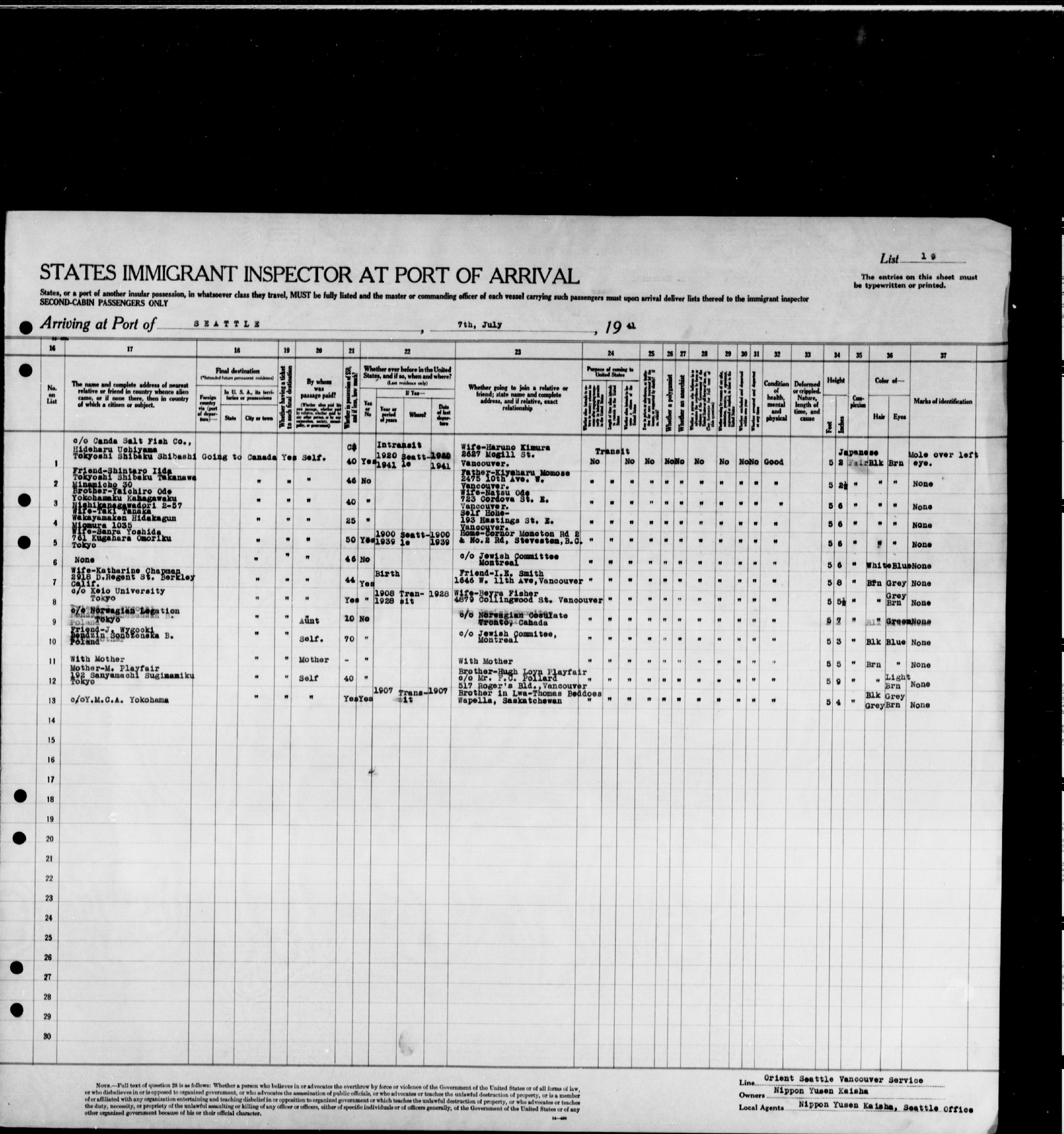
- A ship, arriving at Seattle in 1941: list or manifest of alien passengers, the sheet that names Roza Aszkenazy — US National Archives, Record Group 85 (Immigration and Naturalization Service), Passenger and Crew Lists of Vessels Arriving…
- Arriving at Seattle: the continuation sheet, with the relatives named and the destinations, for the sheet that names Roza Aszkenazy — US National Archives, Record Group 85 (Immigration and Naturalization Service), Passenger and Crew List…