Liwer Abram
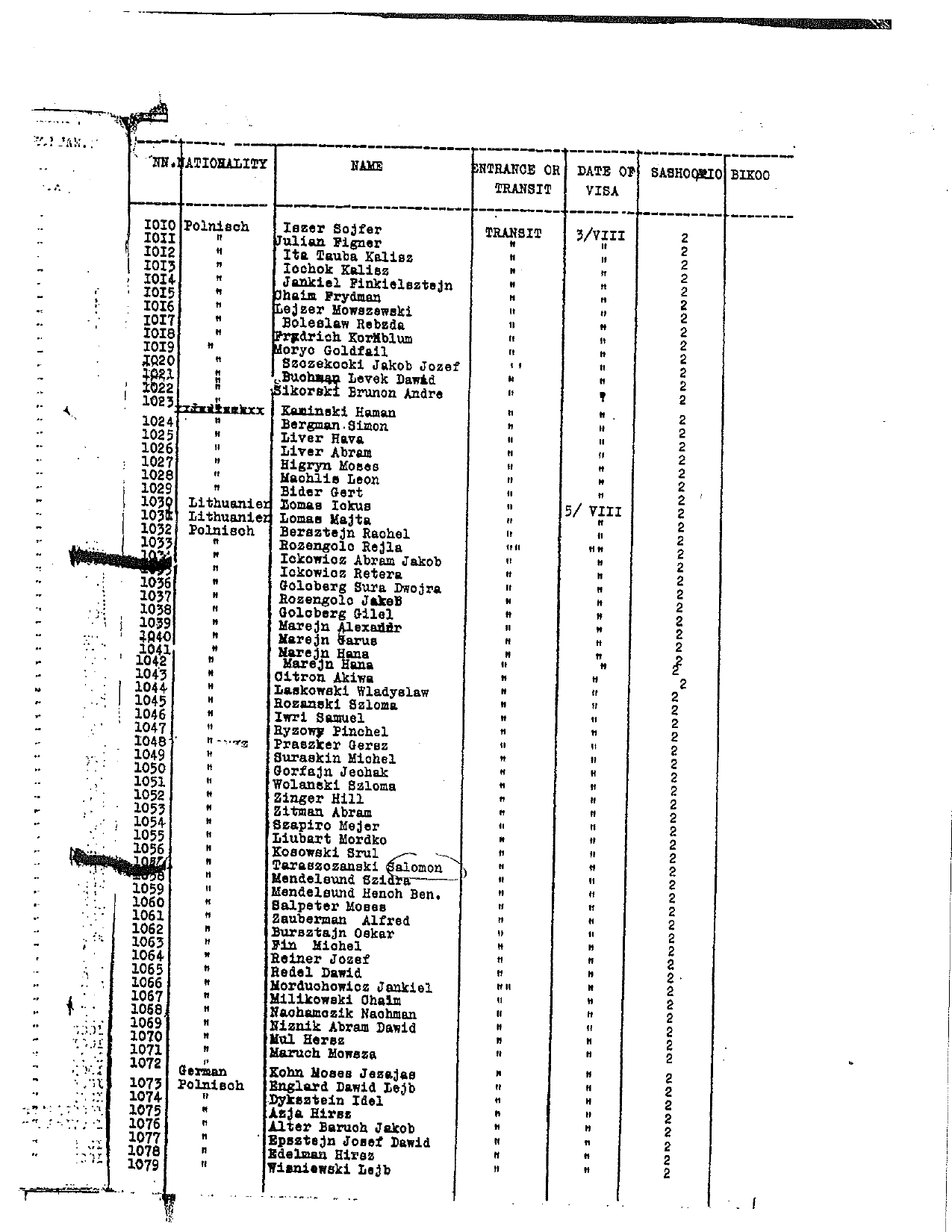
Liwer Abram received transit visa no. 1026 at the Japanese consulate in Kaunas on 3 August 1940. The register records industrialist, aged 48.
What the register records
- Nationality as recorded
- Polnisch
- Age in 1940
- 48
- Occupation
- Industrialist
- Family, per the Kitade-Bluman list
- husband of #1025
The journey
Reached Japan; aided by the Polish ambassador Tadeusz Romer; registered in Kobe for USA.
What is known
Abraham Liwer of Będzin, Poland foresaw the Nazi invasion and urged his family and friends to flee. He fled Będzin with his wife Chawa and daughter Jadzia by train to Warsaw on 1-2 September 1939, in the first days of the invasion. Following a major deportation to Auschwitz in mid-1942, the remaining Jews in town — some 20,000 — were later confined to the Będzin-Kamionka and Sosnowiec-Środula ghettos in early 1943. On a Communist blacklist, he escaped into Lithuania with guides on a freezing New Year's Eve while the border soldiers drank, reached Kaunas, and obtained first a Curaçao declaration from Jan Zwartendijk and then Sugihara transit visas — No.1026 for himself, with his daughter Jadzia written onto it, and No.1025 for his wife Chawa. The family had fled Będzin for Lwów together, and while he was in Lithuania the Soviets deported Chawa and Jadzia to a labour camp in Siberia. Travelling on his Curaçao destination visa, the Japanese transit visa and a thirty-day American transit visa, he reached Vladivostok and from there secured their release — the family believes they were the first Polish Jewish prisoners to get out of Siberia. The three met again in Vladivostok and crossed to Japan together, where the Polish ambassador Tadeusz Romer obtained Canadian visas for Chawa and Jadzia. The three took the Hie Maru; Abraham disembarked at Seattle, while his wife and daughter continued to Vancouver. The family was reunited in New York two years later. A son, Jacques Liwer, had been studying in Belgium: he escaped to England and joined de Gaulle's Free French Forces. This story was contributed by Arlette Liwer-Stuip, granddaughter of Abraham and Chawa Liwer.
His granddaughter Suzanne Hannali counts herself among the tens of thousands of descendants of Sugihara visa holders.
My grandparents, Avram and Chava Liwer, were numbers 1,025 and 1,026, which included my mother, Jadzia Liwer. ... He and my grandfather are the reason I am alive today.
Where this comes from
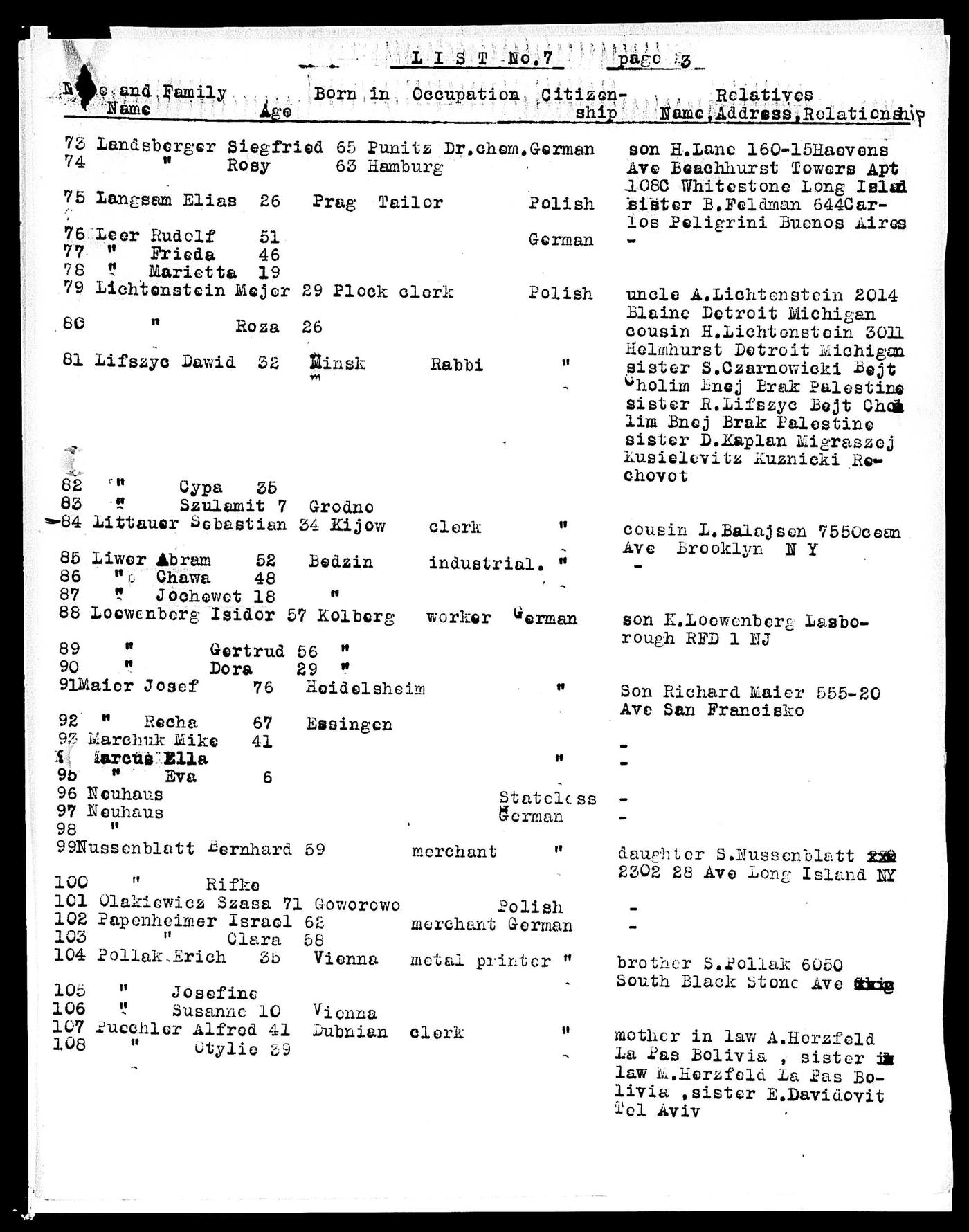
- The Kobe relatives list — refugees at Kobe in 1941 recorded with their relatives abroad. Seventy-six pages in numbered sheets (LIST No. 7, No. 16 and others), each line giving a name, age, birthplace, occupation and citizenship, and then…
Entry 85 of the Kobe community's list of refugees and their relatives abroad: aged 52, born at Bedzin, an industrialist. - US arrival manifest: Abram Liver, Seattle, 1941
"Seattle Passenger Lists", FamilySearch, entry for Abram Liver, 1941. Ship: Hie Maru. Matched from the Hie Maru's Polish-born passenger list (87 people). Register No.1026 'Liver Abram' records age 51; the manifest gives born 1890, arriving 1941. - David Rosen, 'Lithuania to Moscow to Yokohama to Seattle: Holocaust Escape via Japan', Mass-Pocha (Jewish Genealogical Society of Greater Boston), October 2022, pp. 17-21. Reproduces the United States arrival manifest of the M.S. Hie Mar…
The article in which this manifest reaches the archive. David Rosen read the Liwer family's lines out of the original sheet himself and reproduced it here, and he sent the article to the archive in August 2026. The questions it answers are Arlette Liwer-Stuip's, whose research prompted it. What the manifest itself records is set out below, under the sheet. - M.S. Hie Maru, Yokohama 26 June - Seattle 7 July 1941, continuing to Vancouver: the ship's last commercial crossing before she was taken for the Japanese Navy. Read from the manifest reproduced in David Rosen's Mass-Pocha article of Octo…
Line 12 of the Seattle manifest, and the fullest single record the archive holds of one man's crossing. Abram Liver, 51, born 1890 in Poland, co-proprietor of a factory, Polish citizen, Hebrew, reading Polish and German. Column 13 records a United States transit visa issued at MOSCOW on 23 December 1940 - obtained at the American Embassy on his way to Vladivostok, in addition to Zwartendijk's Curaçao notation and Sugihara's transit visa. Stamped ADMITTED over a pencilled 'BSI': he was held for a Board of Special Inquiry, file 424/2860. The hearing let him in on 27 AUGUST 1941, two months after landing, on a $500 bond, with the head tax paid and leave to remain until 14 December 1942. A later hand adds 'Adm. Rouses Point, N.Y. 5/3/43 for perm. res.' - he crossed back from Canada into the United States at the Lake Champlain border post on 3 May 1943 and stayed. The compiled register gives his age as 48; the manifest and his stated birth year make him 51. - List or Manifest of Alien Passengers for the United States - M.S. Hie Maru, which sailed from Kobe on 23 June and from Yokohama on 26 June 1941 and reached Seattle on 7 July 1941; the sheet stamped 34251/10, sailing from Yokohama, ten pa…
Line 1 of the sheet, and the first line the register's Abram Liwer has ever had of his own. LIVER, ABRAM, 51, married, co-proprietor of a bread factory; reads Polish, English and German and writes; Polish nationality, Hebrew; born at Będzin and last resident at Będzin. He travelled on a United States transit visa under section 3(3), number TC 10, issued at Moscow on 23 December 1940. The register gives him as an industrialist, husband of No. 1025, bound for the United States. Four things agree independently of the name: the trade, close to the register's; the Polish nationality; the destination, since he was the one member of the family admitted to the United States while his wife went on to Canada; and Będzin, which is also the birthplace and last residence given for his wife two sheets later on the same voyage. The manifest makes him 51 where the register makes him 48; the register gives the same age, 48, to husband and wife alike, and the wife's 48 is what the manifest confirms. He was one of two men on the sheet held for a Board of Special Inquiry - file 424/2860 - while the rest were admitted on the day of arrival, and the head-tax column records him admitted on 27 August 1941 on a bond of $500, seven weeks after the ship docked. Later hands added that he was admitted at Rouse's Point, New York, in May 1943 for permanent residence, with a stay extended to 14 December 1943 and the head tax paid. - List or Manifest of Alien Passengers for the United States - M.S. Hie Maru, which sailed from Kobe on 23 June and from Yokohama on 26 June 1941 and reached Seattle on 7 July 1941; list 19, the sheet stamped 34251/24, sailing from Yokoham…
This sheet does not carry Abram Liwer; it carries his wife and daughter. Lines 10 and 11 are LIWER Chawa, 48, and LIWER Jochewet, 18, both of Będzin, both marked detained, both identified the next morning and their departure for a foreign port witnessed as the ship went on to Vancouver on Canadian visas. He was listed separately, on the sheet stamped 34251/10 of the same voyage, and was held at Seattle for a Board of Special Inquiry. The register records the same division from the other side and in different words - 'Canada' against her number, 'USA' against his - and the two records were compiled independently. - Arlette Liwer-Stuip, account written for this archive of her grandfather ABRAM (AVRAM) LIWER, register No. 1026, and his wife CHAWA, No. 1025 — the flight from Będzin, the crossing into Lithuania, the Curaçao declaration from Jan Zwarten…
His granddaughter's written account of the flight from Będzin, the Curaçao declaration and the Sugihara visas, the deportation to Siberia, and the reunion in New York. Given by Arlette Liwer. - stuip-2026-08-04: The Liwers for Chaim's site — a document sent to the archive by a correspondent. Abraham Liwer, born in Będzin, Poland, 1892. On Chiune Sugihara’s official list – No. 1026
Also known as / spellings: Abram Liver Polish .…
His granddaughter's written account of the flight from Będzin, the Curaçao declaration and the Sugihara visas, the deportation to Siberia, and the reunion in New York. Given by Arlette Liwer. - David Rosen, 'Lithuania to Moscow to Yokohama to Seattle: Holocaust Escape via Japan', Mass-Pocha (Jewish Genealogical Society of Greater Boston), October 2022, page 17 — the article as printed, the first of five pages. It opens with the…
All five printed pages of the article reconstructing this family's crossing, given by its author David Rosen. - David Rosen, 'Lithuania to Moscow to Yokohama to Seattle', Mass-Pocha, October 2022, page 18 — the second printed page, and the one that reproduces the United States arrival manifest of the Hie Maru at Seattle. Two strips of the manifest…
All five printed pages of the article reconstructing this family's crossing, given by its author David Rosen. - David Rosen, 'Lithuania to Moscow to Yokohama to Seattle', Mass-Pocha, October 2022, page 20 — the fourth printed page, on tracing the two women's onward crossing from Canada back into the United States. It sets out the two collections o…
Amended 21 September 2026: until this date this page let the 1943 border-crossing record's 'born 1924 at Bedzin' stand as Jochewet Liwer's date and place of birth, and read the age of 18 on the Hie Maru manifest as her age. She was born on 4 December 1920 at Szydłowiec, where her mother went home to give birth; the ages on both records are the ages that were given for her, not her age. Chawa's granddaughter Arlette Liwer, 14 September 2026. | All five printed pages of the article reconstructing this family's crossing, given by its author David Rosen. - "Washington, King, Seattle, Passenger Lists, 1890-1957", FamilySearch — index entry for Abram Liver, 1941: born about 1890, Poland. Digitised from NARA microfilm publication M1383 (passenger and crew lists of vessels arriving at Seattle)…
FamilySearch's index of the Seattle passenger lists, read by the archive on 20 September 2026, has Abram Liver, born about 1890 in Poland, arriving at Seattle in 1941. The register's compiled line gives 1892, and the two are 2 years apart. The name occurs once on the register, and a Polish-born passenger landing at Seattle in 1941 fits the route through Japan, so the entry is taken as this person's under the archive's rule of 19 September 2026 for records from the route. - JDC Archives, New York, collection AR 33/44 file 53 (the Jewish Community of Ko… — "List of departures for the month of June, 1941" (Jewish Community of Kobe, Migration Office; covering letter p. 12, Kobe, July 1941, HICEM-funded tickets)
He left Yokohama on the Hie Maru on 26 June 1941, bound for the USA (the Jewish Community of Kobe's list of departures, June 1941 (JDC Archives, AR 33/44 file 53)). The list reads: Hie Maru sheet: "Liwer Abraham — 1 — U.S.A.". (Hie Maru, Yokohama, 26 June 1941, the USA and Canada.) - Casablanca of the North: Kaunas 1939–1940 (exhibition catalogue), Linas Venclauskas (compiler), Sugihara Diplomats for Life Foundation, Kaunas, 2018
The Sugihara House exhibition catalogue (Linas Venclauskas, Sugihara Diplomats for Life Foundation, 2018) reproduces Abram Liwer's request of 25 July 1940, as a war refugee from Będzin, to bring his wife and daughter to Lithuania so that they could emigrate, and the Commissar for War Refugees' reply of 31 July 1940 naming his wife Chava and daughter Jochevet. - Suzanne Hannali (Facebook): grandparents Avram and Chava Liwer, Sugihara list Nos. 1025-1026, with daughter Jadzia — escape from Będzin, Poland
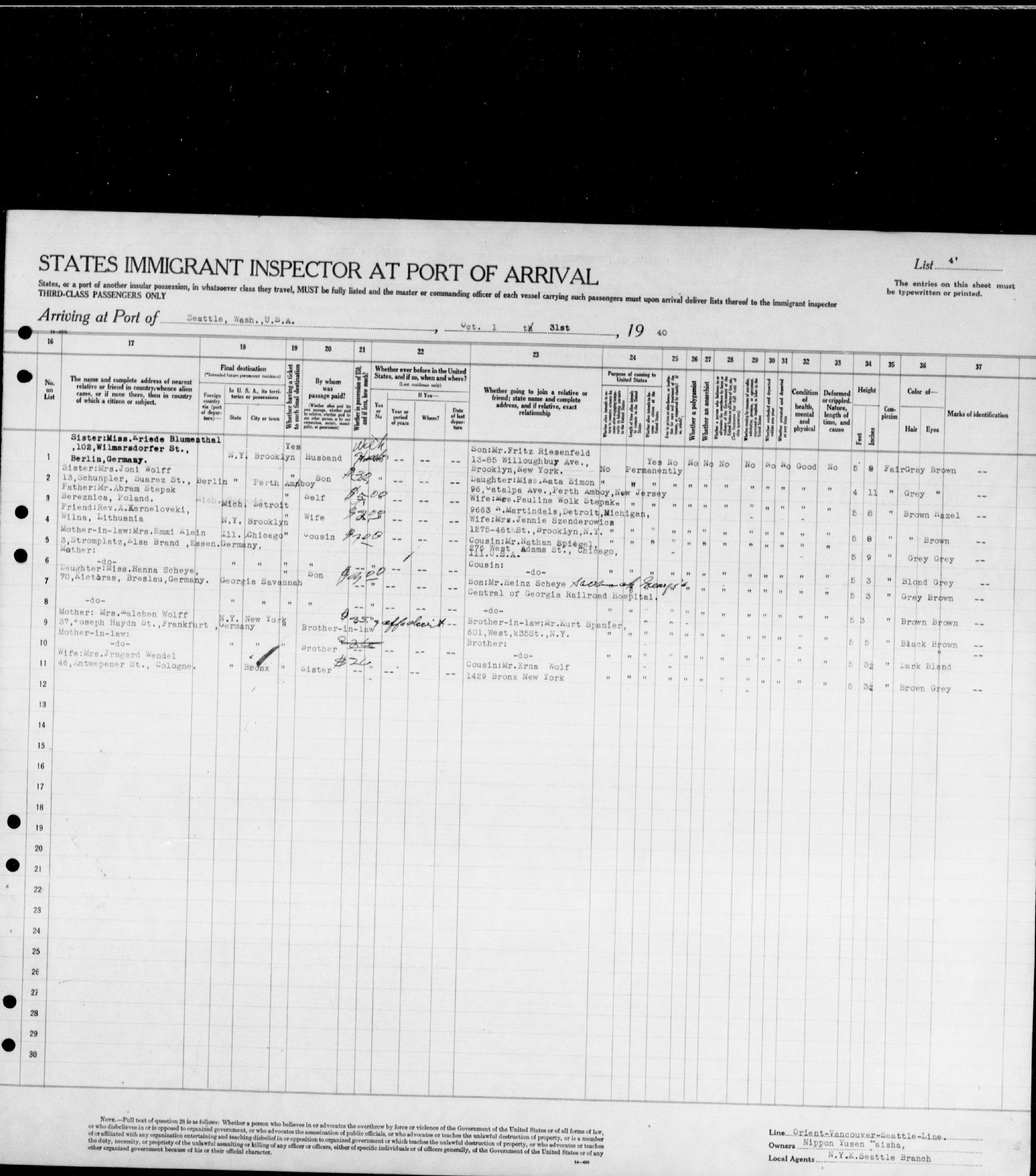
- The HEIAN, arriving at Seattle in 1940: list or manifest of alien passengers, the sheet that names Icko Stepak — US National Archives, Record Group 85 (Immigration and Naturalization Service), Passenger and Crew Lists of Vessels Arriving…