Bluman Nuta
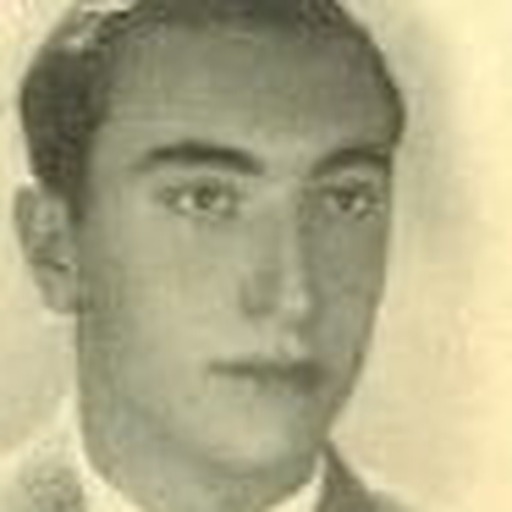
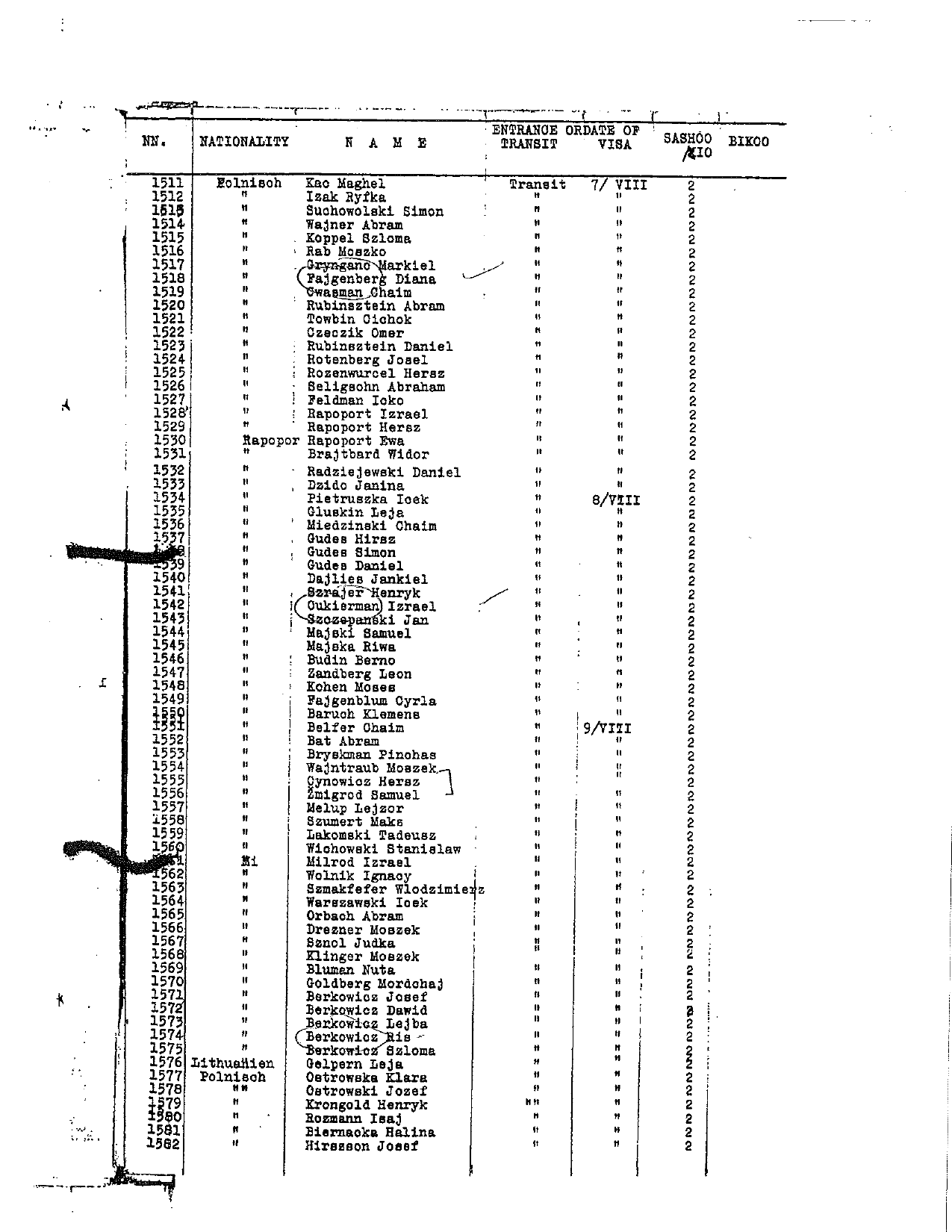
Bluman Nuta received transit visa no. 1569 at the Japanese consulate in Kaunas on 9 August 1940. The register records engineer, aged 25.
Documents
| Name | Nuta Bluman |
|---|---|
| Citizenship | Polnisch [Polish] |
| Visa | Transit |
| Issued | 9 Aug 1940 · arrived in Japan 2 Feb 1941 |
| Line | 1569 |
What the register records
- Nationality as recorded
- Polnisch
- Age in 1940
- 25
- Occupation
- Engineer
- Family, per the Kitade-Bluman list
- wife Zysla (19)
The journey
Reached Japan; aided by the Polish ambassador Tadeusz Romer; registered in Kobe for Canada.
Travelled with, and never given a number
- Susan (Zysla) Bluman — wife, aged 20
- Zysla — wife, aged 20
The register recorded visa holders. It did not reliably record the wives and children who travelled on somebody else’s visa, so these people have no entry of their own and cannot be searched for. Where the archive has recovered a name, it is here.
What is known
Susan was 19 when Germany invaded Poland in 1939. Her boyfriend Nathan was in Lvov during the Soviet occupation and arranged for a guide to bring her from Warsaw to the Soviet zone, where they married. The couple fled across the Lithuanian border to Vilna, where after being rejected by every consulate they heard of Chiune Sugihara. Nathan met with Sugihara, who granted them a transit visa despite their lacking a destination visa; because Susan had no passport she was added to Nathan's. They left Lithuania in January 1941, traveled the Trans-Siberian Railroad to Japan, and, since Nathan was an engineer, gained entry to Canada, leaving Japan for Vancouver in June 1941.
Susan Bluman's own story was written down by her daughter. I Have My Mother's Eyes: A Holocaust Memoir Across Generations (Ronsdale Press, Vancouver, 2009), by Barbara Ruth Bluman, carries her mother's account of the flight from Warsaw to Vilna, the Sugihara visa of 9 August 1940, and the journey on to Canada — and her daughter's carrying of it a generation further. Her son, Prof. George Bluman, whose reconciliation of the register underlies much of this archive, gave the archive the title on 25 August 2026 and asked that it stand here, on his mother's entry.
Susan was 19 when Germany invaded Poland in 1939. She traveled to the Soviet zone to join her boyfriend Nathan in Lvov, where they married, then fled to Vilna where they stayed for a year. They received a Japanese transit visa and left Lithuania in January 1941, traveling the Trans-Siberian Railroad to Japan; Nathan, an engineer, secured entry to Canada, and the couple left Japan for Vancouver in June 1941.
No one wanted us. We were just rejected by all the consulates, by all the embassies. We were desperate, absolutely desperate. And despite that we did not have a visa to get somewhere--because transit visa is only to get you somewhere--Consul Sugihara granted us this wonderful visa for life, this transit visa. The problem was that I did not have a passport, so my husband had then difficulties putting me on...me on his passport.
They received a visa for transit through Japan and left Lithuania in January 1941, traveling across the Trans-Siberian Railroad to Japan. Susan and her husband left Japan for Vancouver, Canada, in June 1941.
Where this comes from
- The JEWCOM register — the refugee register kept by the Refugee Committee of the Jewish Community of Kobe (Ashkenazim) at No. 6 Yamamoto-dori, 1-chome, whose cable address was 'JEWCOM Kobe'. Eighty-four pages on the committee's own printe…
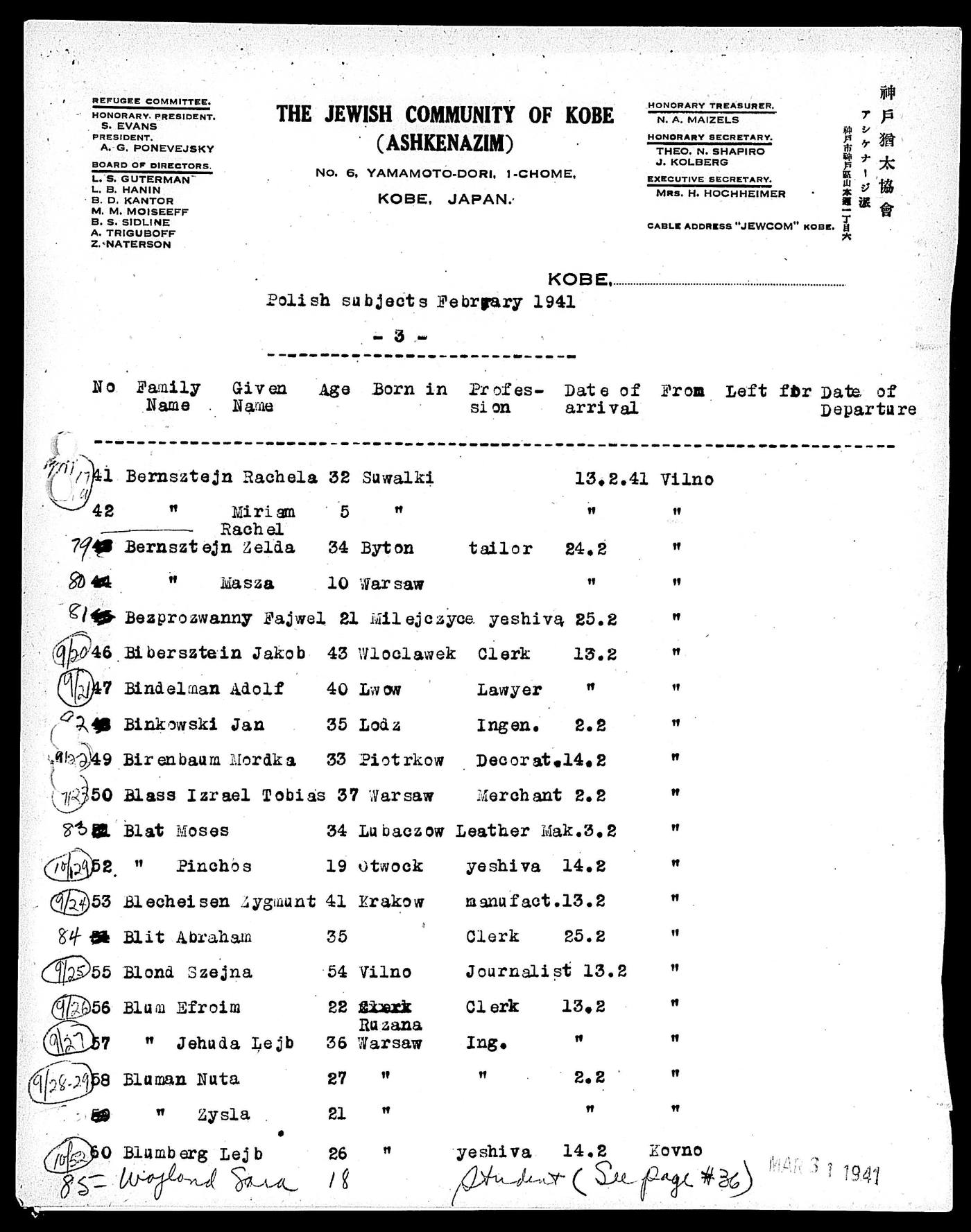
Entry 58 of the Kobe Jewish Community's refugee register: aged 27, born at Warsaw, who arrived in Japan from Vilnius on 2 February 1941. - Nathan (Nuta) Bluman — vhec.org
Zachor, Vancouver Holocaust Education Centre, Fall 2015 - the issue accompanies a Kristallnacht lecture by Dr George Bluman, who compiled the numbered Sugihara list this archive rests on. It gives his parents' journey entire: Natek and Zosia Bluman (later Nathan and Susan) fled Warsaw to Lithuania a - group portrait, Kobe — collections.ushmm.org
USHMM photograph 07665: 'Group portrait of Jewish refugees in Kobe, Japan, who escaped from Europe with visas signed by Chiune Sugihara', 25 May 1941, courtesy of Eric Saul. The museum's record names nobody. The same photograph is published in Zachor (Vancouver Holocaust Education Centre, Fall 2015) - US arrival manifest: Nuta Bluman, Seattle, 1941
"Seattle Passenger Lists", FamilySearch, entry for Nuta Bluman, 1941. Ship: Heian Maru. Matched from the Heian Maru's Polish-born passenger list (198 people, of whom 57 matched the register). Register No.1569 'Bluman Nuta' records age 26; the manifest gives born 1914, arriving 1941. Confidenc - US arrival manifest: Nuta Bluman, Seattle, 1941
"Seattle Passenger Lists", FamilySearch, entry for Nuta Bluman, 1941. Ship: Hie Maru. Matched from the Hie Maru's Polish-born passenger list (87 people). Register No.1569 'Bluman Nuta' records age 26; the manifest gives born 1914, arriving 1941. - United States Holocaust Memorial Museum, Holocaust Survivors and Victims Database — the Flight and Rescue electronic dataset (source 20725): USHMM's own transcription of the Kaunas register, 2,140 persons with citizenship, visa type, iss…
USHMM Flight and Rescue dataset: arrived in Japan 2 Feb 1941 (line 1569) - Oral history interview with Susan Bluman (née Hoffenberg) — USC Shoah Foundation Visual History Archive, interview 12262. Catalogue: born Sep 1 1920, Warsaw (Warsaw, Poland); born Warsaw 1 Sep 1920; wife o… — the interviewee may be living
USC Shoah Foundation VHA interview 12262: Susan Bluman (née Hoffenberg) — the interviewee herself — wife of Nathan Bluman — gave a testimony (catalogue: born Sep 1 1920, Warsaw (Warsaw, Poland)); born Warsaw 1 Sep 1920; wife of No.1569 Nuta (Nathan) Bluman; mother of Prof. George Bluman - List or Manifest of Alien Passengers for the United States - M.S. Hie Maru, which sailed from Kobe on 23 June and from Yokohama on 26 June 1941 and reached Seattle on 7 Jul… — the sheet David Rosen pointed the archive to on 30 August 2026
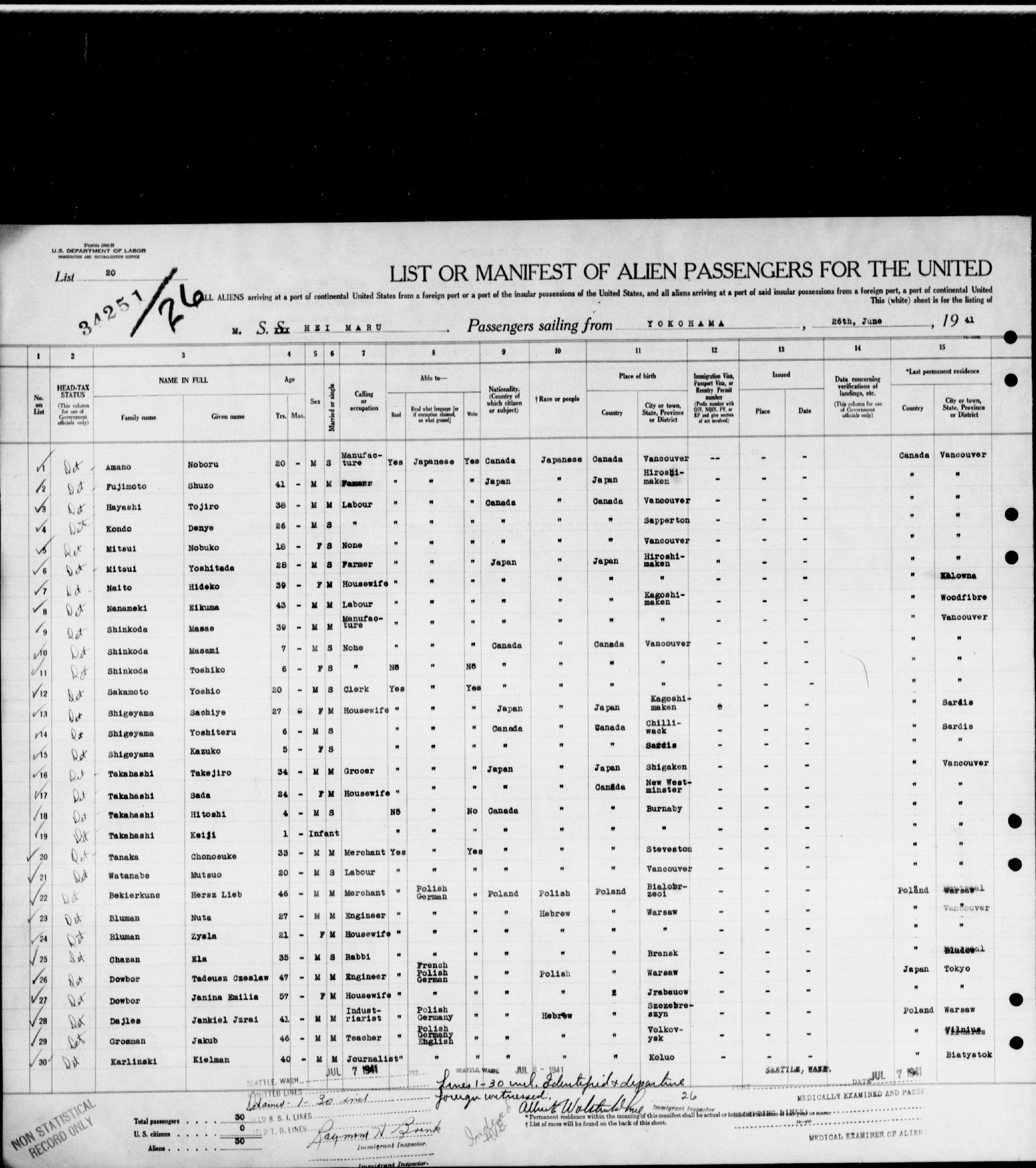
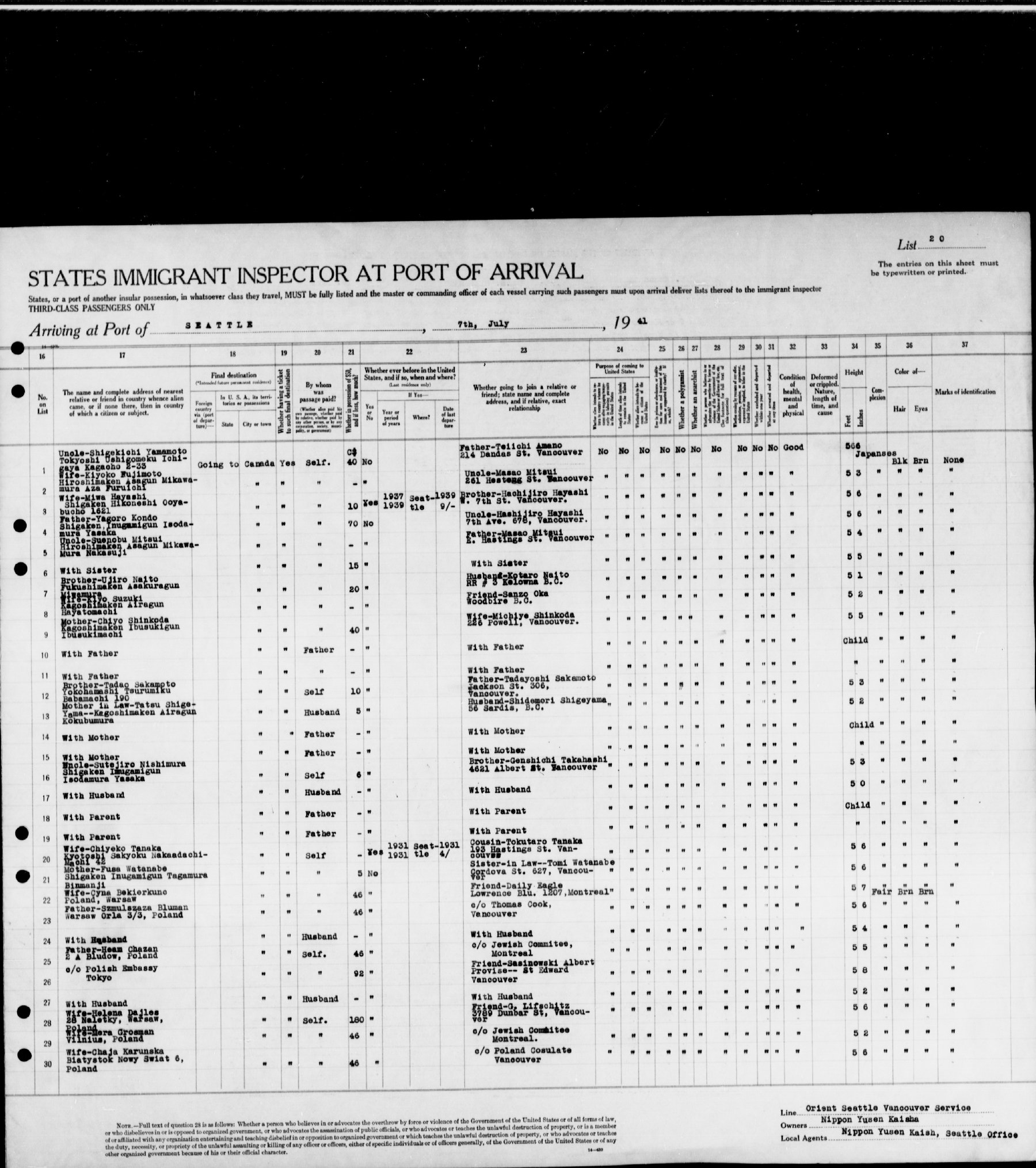
Line 23 of the sheet. BLUMAN, NUTA, 27, male, married, engineer; Polish nationality, Hebrew; born at Warsaw and last resident at Warsaw. His nearest relative in the country he came from is given as his father, Szmul-Szaja Bluman, of Orla 3/3, Warsaw; his final destination is entered as going to Canada; and in Canada he was to be met care of Thomas Cook at Vancouver. He paid his own passage and showed $46. The register has him as Bluman Nuta, an engineer, with a wife Zysla, going to Canada. Four independent agreements: the trade, the destination, the wife on the very next line of the same sheet, and the age, 25 on a list compiled in 1940 against 27 in July 1941. He was detained on board at Seattle on 7 July 1941 with everyone else on the sheet and identified the next day. - List or Manifest of Alien Passengers for the United States - M.S. Hie Maru, which sailed from Kobe on 23 June and from Yokohama on 26 June 1941 and reached Seattle on 7 Jul… — the sheet David Rosen pointed the archive to on 30 August 2026
Line 24, immediately below her husband. BLUMAN, ZYSLA, 21, female, married, housewife; Polish nationality, Hebrew; born and last resident at Warsaw; the relative column reads simply 'With Husband', and her passage was paid by him. The register names her in the entry for No. 1569 - wife Zysla, 19 - and it is her presence on the line below his that turns a matching surname and trade into an identification. - Barbara Ruth Bluman, 'I Have My Mother's Eyes: A Holocaust Memoir Across Generations' (Ronsdale Press, Vancouver, 2009) — the memoir of Susan (Zysla) Bluman, register No. 1569, written by her daughter. The title was given to the archive…
The memoir of Zysla (Susan) Bluman, written by her daughter. The arrival sheet already on this entry carries Nuta Bluman on one line and Zysla Bluman immediately below, as husband and wife. Given by her son, George Bluman, with the request that it be cited on her entry. - "California, San Francisco, Passenger Lists, 1893-1953", FamilySearch — index entry for Danuta Bluman, 1947: born about 1914, Poland. Digitised from NARA microfilm publication M1410 (passenger lists of vessels arriving at San Francisco).…
FamilySearch's index of the San Francisco passenger lists, read by the archive on 20 September 2026, has Danuta Bluman, born about 1914 in Poland, arriving at San Francisco in 1947 on the Marine Phoenix. The register's compiled line gives 1915, and the two are 1 year apart, and the name occurs once on the register. The sheet names the ship but its heading could not be read for the port she sailed from, so this is held as a lead until it can. The sheet is NARA microfilm publication M1410, film 394, image 402, read by the archive on 20 September 2026. - "Washington, King, Seattle, Passenger Lists, 1890-1957", FamilySearch — index entry for Nuta Bluman, 1941: born about 1914, Poland. Digitised from NARA microfilm publication M1383 (passenger and crew lists of vessels arriving at Seattle)…
FamilySearch's index of the Seattle passenger lists, read by the archive on 20 September 2026, has Nuta Bluman, born about 1914 in Poland, arriving at Seattle in 1941. The register's compiled line gives 1915, and the two are 1 year apart. The name occurs once on the register, and a Polish-born passenger landing at Seattle in 1941 fits the route through Japan, so the entry is taken as this person's under the archive's rule of 19 September 2026 for records from the route. - JDC Archives, New York, collection AR 33/44 file 53 (the Jewish Community of Ko… — "List of departures for the month of June, 1941" (Jewish Community of Kobe, Migration Office; covering letter p. 12, Kobe, July 1941, HICEM-funded tickets)
He left Yokohama on the Hie Maru on 26 June 1941, bound for Canada (the Jewish Community of Kobe's list of departures, June 1941 (JDC Archives, AR 33/44 file 53)). The list reads: Hie Maru sheet: "BLUMAN Nuta & wife Zysla — 2 — Canada". (Hie Maru, Yokohama, 26 June 1941, the USA and Canada.) - List of Refugees, Vilna, 1940 — JDC Archives, New York, collection AR 33/44, file 00876. The contemporary register of Polish Jewish refugees in Lithuania, running to more than nine thousand numbered entries; the fullest independent check…
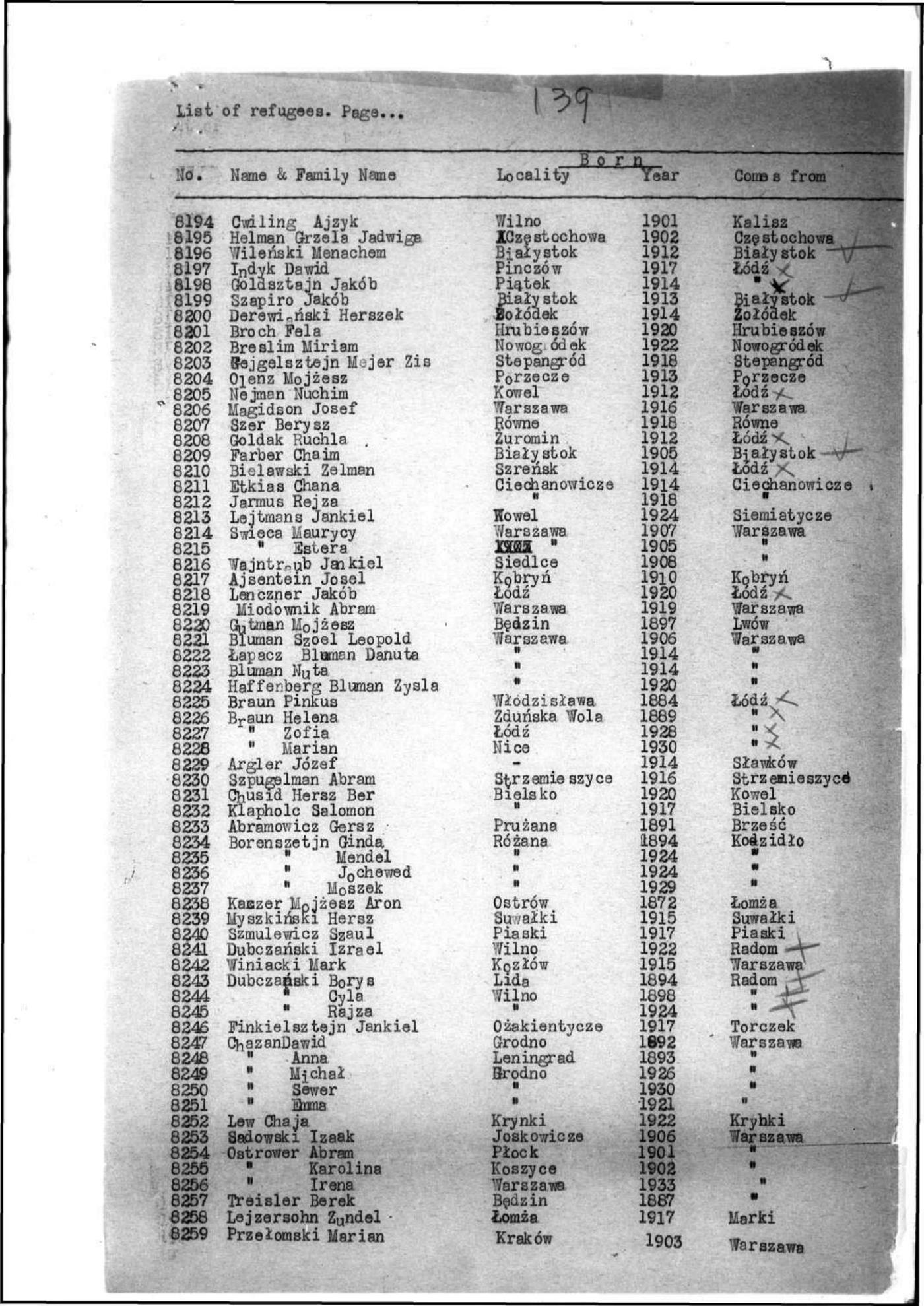
The 1940 Vilna refugee list has, at entry 8223, Nuta Bluman, born in 1914. - Oral history interview with Susan Bluman — United States Holocaust Memorial Museum, Flight and Rescue collection (RG-50.494.0015)
In her oral history for the United States Holocaust Memorial Museum, Susan (Zysla) Bluman says that her husband Nathan left Warsaw with his father and brothers on 6-7 September 1939, and that she crossed to the Soviet zone three months later to join him at Lwow, where they were married on 26 December 1939. They crossed into Lithuania in the snow in January 1940, through the border village of Ejszyszki, and took a job as agricultural instructor at the Hakhshara, the young pioneers' farm at Kedainiai, from spring 1940. When they heard about the Japanese consul, the Dutch honorary consul had already left, but Sugihara gave Nathan a transit visa without a Curacao note. She says the NKVD kept their passports for two weeks before granting an exit visa, and that an Intourist clerk, after they said they had only 100 dollars, sold them train tickets for 50. They crossed Siberia in third class in ten or twelve days, were blacked out at Vladivostok, and sailed to Tsuruga in January in a freighter in rough seas. In Kobe they lived in one of the houses the Joint rented, with some 28 young refugees, slept on mats, used the bath house next door, and held a Passover seder with matzah. Nathan went repeatedly to Tokyo, where the Polish embassy had about twenty visas for professionals to go to Canada; he refused to go without her, she was summoned by cable to Tokyo, a second visa was found, and the pair sailed on 26 June 1941. In Canada Nathan could not find work as an engineer; he worked in a meat-packing house, then took a lathe course and worked at Boeing in Vancouver, and in 1943 joined the Canadian army although he could have been exempted. Postcards and parcels went to Susan's family in the Warsaw ghetto from Kobe, and letters reached them through Nathan's former employer in New York until Pearl Harbor. She learned from a letter from a relative in Palestine in 1946 that her father had died of typhus in 1942 and that her mother, brother and sisters died in the Poniatowa killings. She says she did not know the name Sugihara until 1985. - Bluman family, George Bluman, "The story of a Jewish family saved by Sugihara Visas", 2014 — YouTube
George Bluman said in 2014 that his father, an engineer, got his transit visa on 9 August 1940, a few days after his uncle, and that the family travelled from Moscow in January 1941, across Siberia to Vladivostok and on the Amakusa Maru to Tsuruga. His parents found a place in Canada through a chance meeting in Tokyo with a former Warsaw professor on 25 June 1941 and left on what he called the very last boat to Vancouver (about three to nine minutes in). - Jewish Independent (Vancouver), 13 November 2015, 'Consuls save thousands of lives'
The Jewish Independent of Vancouver reported on 13 November 2015 that Nathan and Susan Bluman, who had lived in Warsaw, received Sugihara visas, travelled across Siberia to Kobe and sailed on one of the last two ships to North America before Pearl Harbor; their son gave the keynote at the event reported. - Jewish Independent (Vancouver), 31 January 2020, 'War heroism recalled'
The Jewish Independent of Vancouver wrote on 31 January 2020 that Nathan and Susan Bluman fled to Lithuania in 1939, received Sugihara transit visas, travelled through the Soviet Union to Japan and sailed on the last ship from Japan to Vancouver before Pearl Harbor. - Jewish Independent (Vancouver), 27 October 2023, 'Trauma, loss and hope' — on the opera drawn from Barbara Bluman's book about her mother Susan Bluman
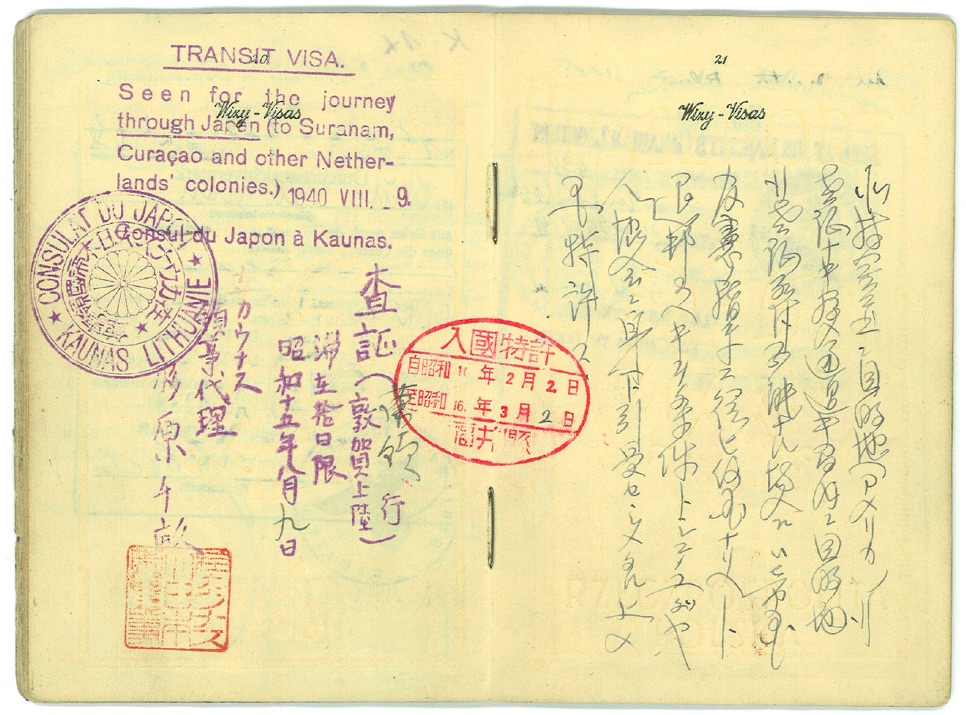
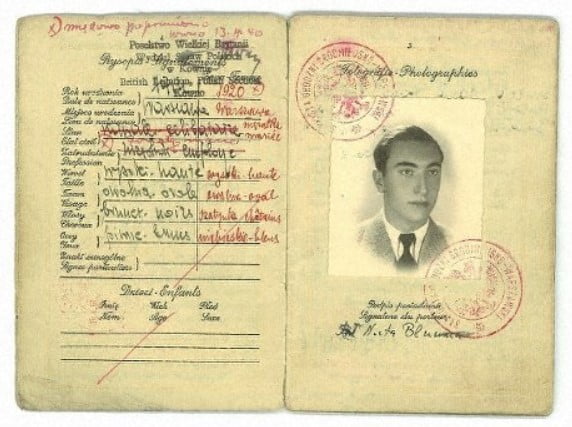
On 27 October 2023 the Jewish Independent of Vancouver wrote about the opera drawn from Barbara Bluman's book about her mother, Susan Bluman, who reached Vancouver in July 1941 after the Sugihara rescue; the article, quoting her son, gives her years as 1920 to 2004. - A visa page with the Sugihara transit visa of 9 August 1940 and a Japanese landing stamp, facing a page of Japanese endorsements.
- The Sugihara transit visa of 9 August 1940 and a page of Japanese endorsements, a black-and-white reproduction.
- The Sugihara transit visa of 9 August 1940 with a Japanese landing stamp, facing a page of Japanese endorsements, a black-and-white reproduction.
- The Sugihara transit visa of 9 August 1940 and a Japanese landing stamp, facing a page of Japanese endorsements, a toned reproduction.
- Life-saving visa by Chiune Sugihara
- A document held in the archive's files
- A document held in the archive's files
- https://personal.math.ubc.ca/~bluman/ChiuneSugiharaLists.html
- Chiune Sugihara | Holocaust Encyclopedia
- Susan Bluman describes obtaining a transit visa from Chiune Sugihara | Holocaust Encyclopedia
- History of Jewish Kobe, Japan: Introduction and Summary of Lisa Sopher's Notes from Interviews Conducted together with S. David Moche About the History of Jewish Life in Kobe, Japan 1936 - 2000
- Tom Topol, passport-collector.com: Nathan Bluman's passport (visa 9 Aug 1940) entrusted by sons George & Bob Bluman to the NPO Chiune Sugihara Visas For Life museum, Tokyo (Yaesu)
- Oral history interview with Susan Bluman — United States Holocaust Memorial Museum, Flight and Rescue collection (RG-50.494.0015)
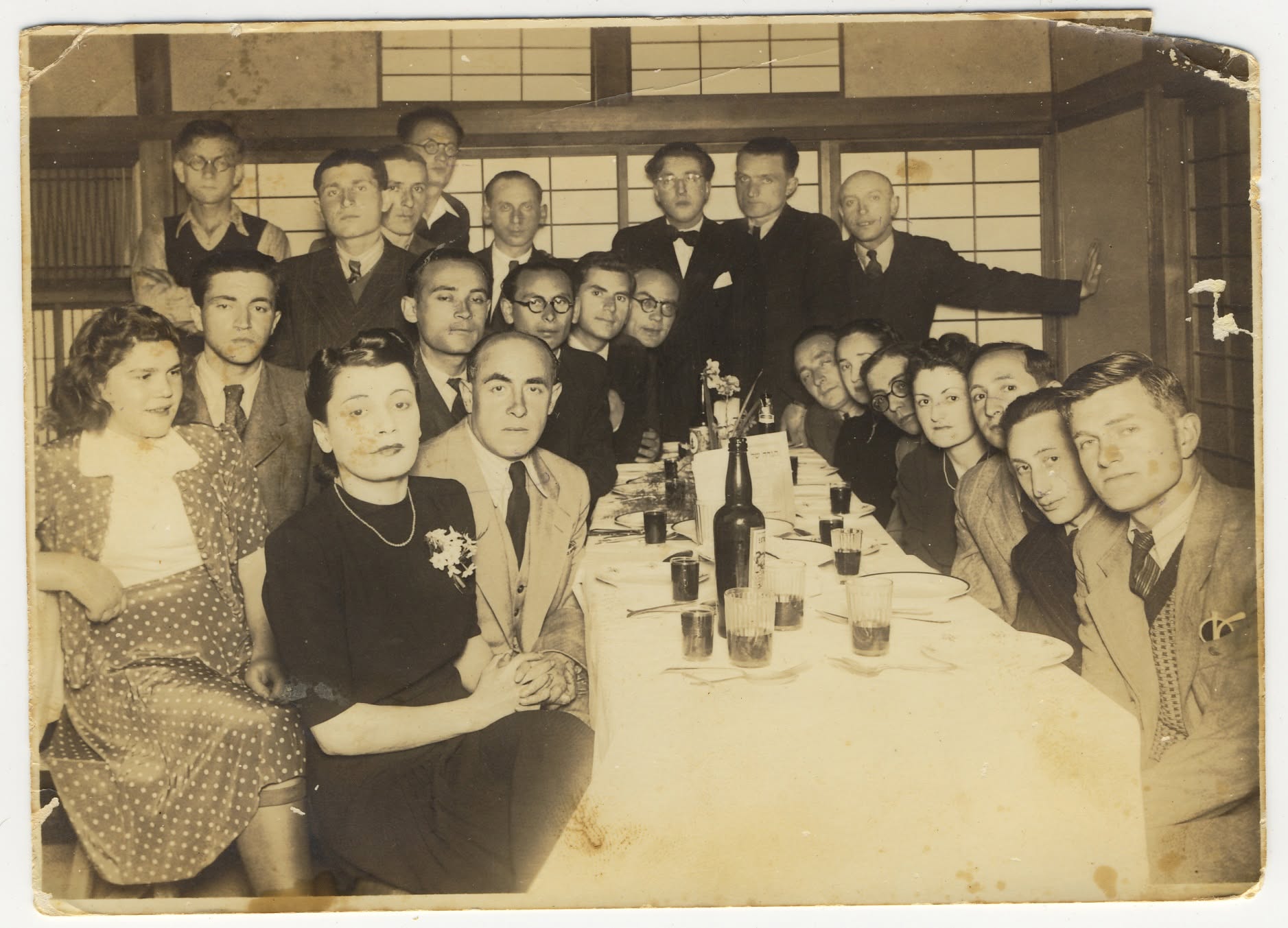
- Passover Seder in Kobe, spring 1941 — some two dozen refugees around a laid table, a Haggadah among the glasses, two Japanese guests standing at the rear; Dawid Apotheker sits first from the right; the couple at his right are Nathan and…
- Oral history interview with Susan Bluman (née Hoffenberg) — USC Shoah Foundation Visual History Archive, interview 12262. Catalogue: born Sep 1 1920, Warsaw (Warsaw, Poland); born Warsaw 1 Sep 1920; wife o… — the interviewee may be living
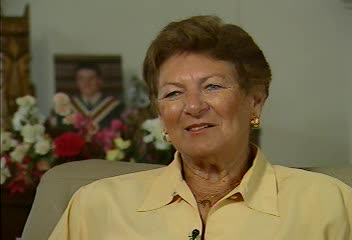
- Catalogue still for the oral history of Susan Bluman (née Hoffenberg) — USC Shoah Foundation Visual History Archive, interview 12262 (the archive's public catalogue frame, 352x240); links to the testimony at vha.usc.edu/testimony/12262
- The Hie Maru, arriving at Seattle in 1941: list or manifest of alien passengers, the sheet that names Kielman Karlinski — US National Archives, Record Group 85 (Immigration and Naturalization Service), Passenger and Crew Lists of Vessels…
- Arriving at Seattle: the continuation sheet, with the relatives named and the destinations, for the sheet that names Karlinski Zelman — US National Archives, Record Group 85 (Immigration and Naturalization Service), Passenger and Crew Li…

