Erlich Wiktor
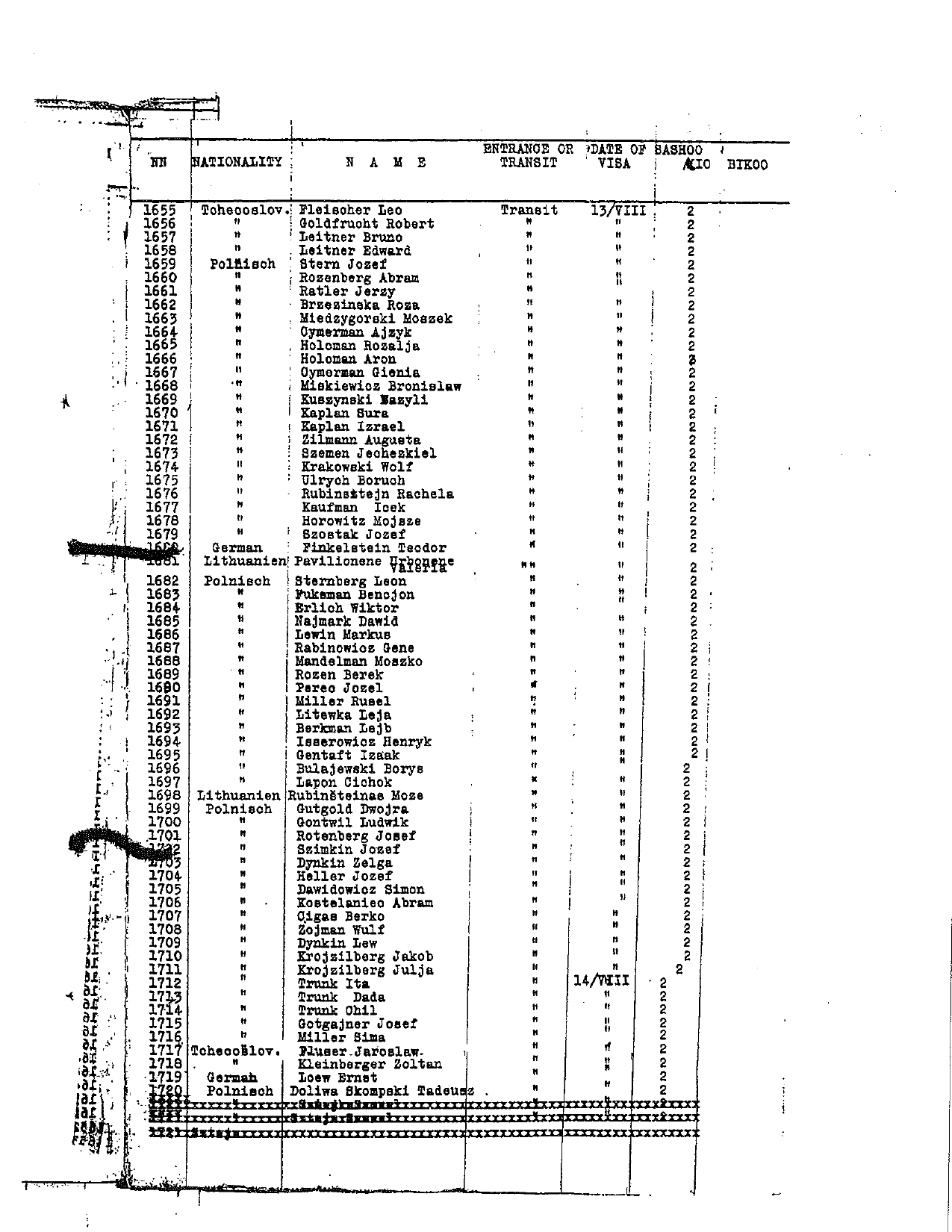
Erlich Wiktor received transit visa no. 1684 at the Japanese consulate in Kaunas on 13 August 1940. The register records journalist, aged 25.
Documents
| Name | Wiktor Erlich |
|---|---|
| Citizenship | Polnisch [Polish] |
| Visa | Transit |
| Issued | 13 Aug 1940 · arrived in Japan 13 Feb 1941 |
| Line | 1684 |
What the register records
- Nationality as recorded
- Polnisch
- Age in 1940
- 25
- Occupation
- Journalist
- Family, per the Kitade-Bluman list
- wife Iza (20), son of #1727
The journey
Reached Japan; registered in Kobe for Canada.
Travelled with, and never given a number
- Iza — wife, aged 20
The register recorded visa holders. It did not reliably record the wives and children who travelled on somebody else’s visa, so these people have no entry of their own and cannot be searched for. Where the archive has recovered a name, it is here.
What is known
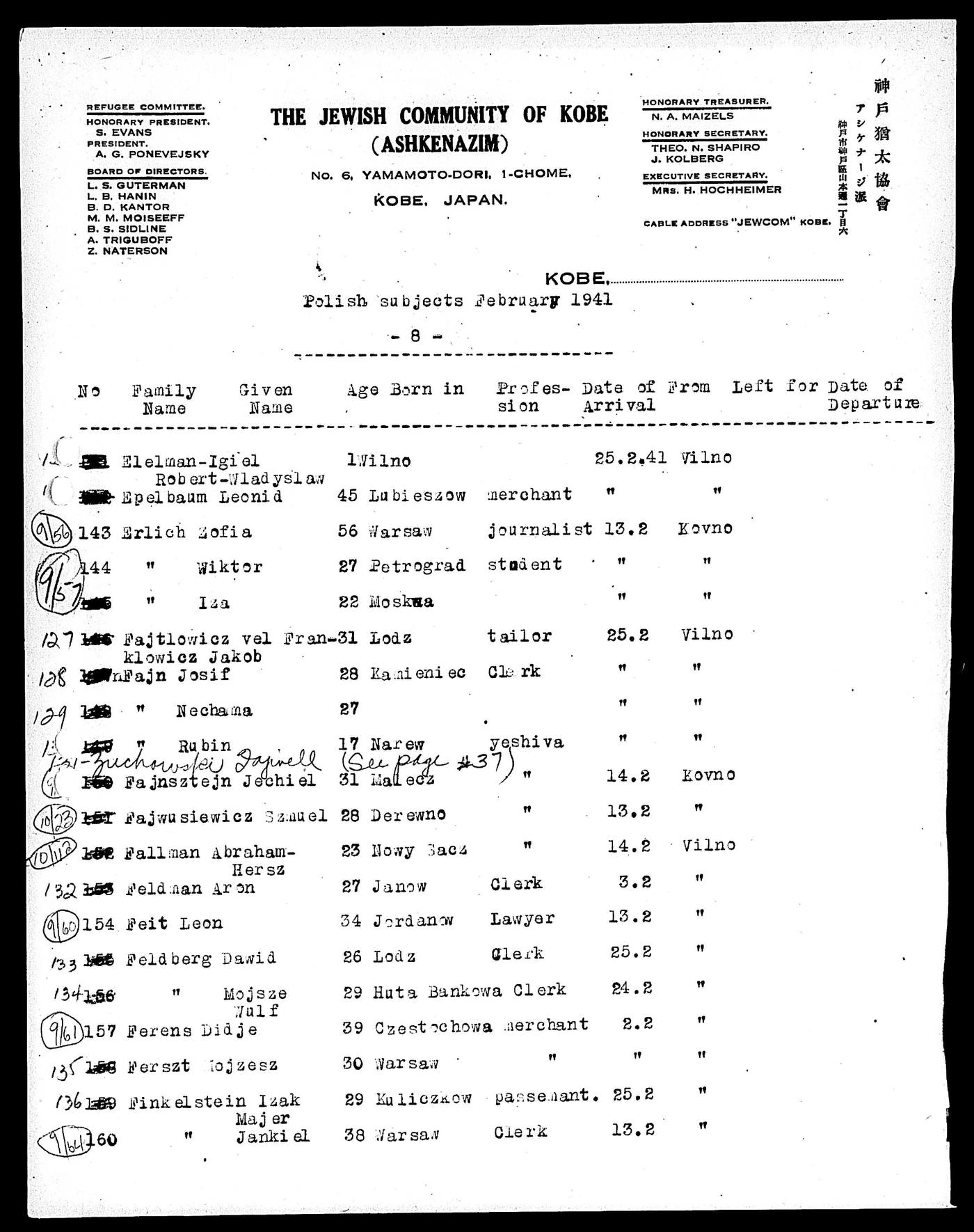
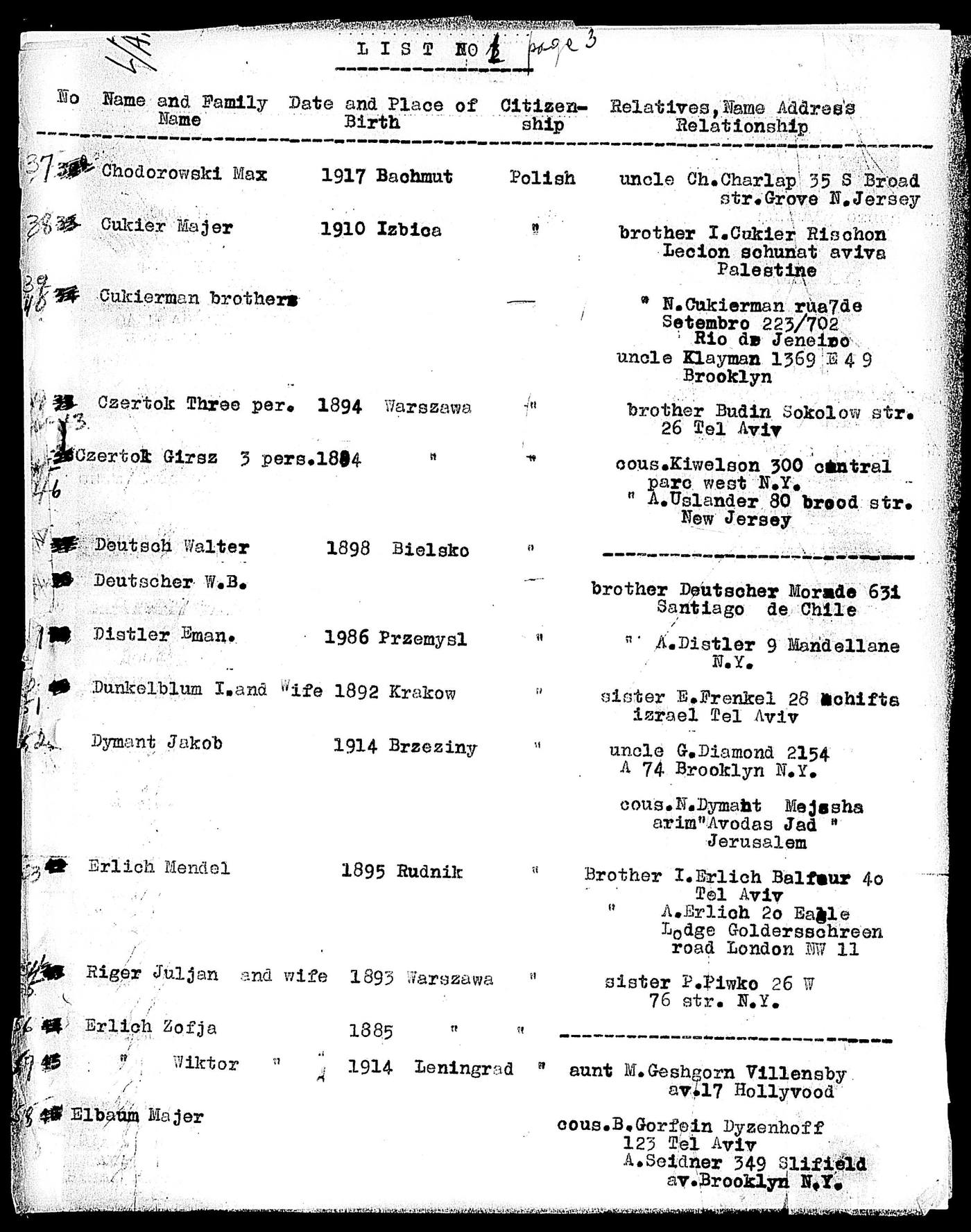
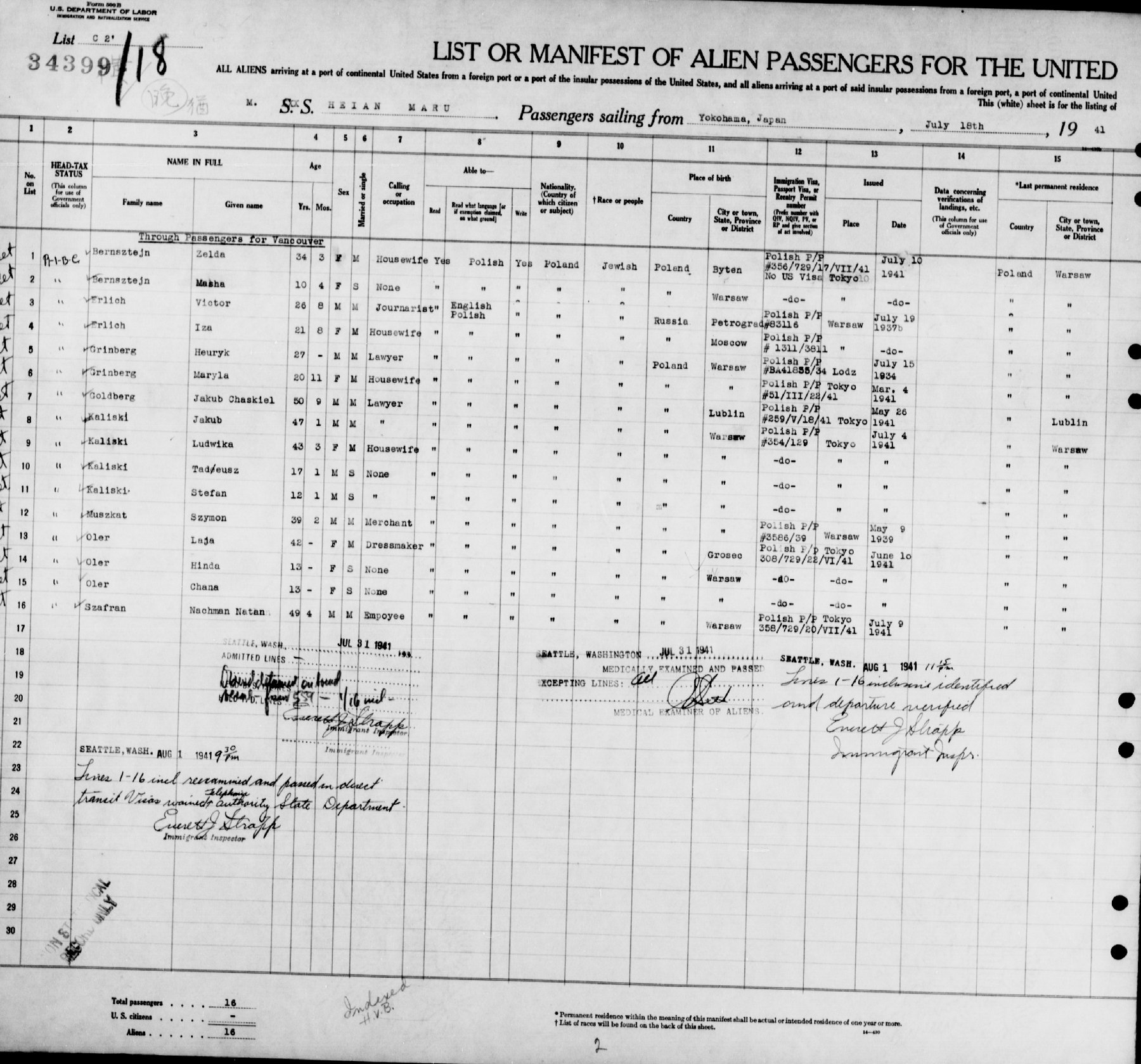
Wiktor Erlich, a journalist born at Leningrad in 1914, the son of No. 1727, received Sugihara's transit visa at Kaunas on 13 August 1940; the typed line has lost the first letter of his given name. In his oral history for the Holocaust Memorial Museum in 1999 he told how he left Warsaw with his parents on 6 and 7 September 1939, reached Pinsk, and saw his father arrested at Brest-Litovsk on 1 October. He went on to Vilna and Kaunas, where, as relatives of the Bund leader Henryk Erlich, the family was sought by the NKVD; he, his mother and his wife travelled together by the Trans-Siberian Express in twelve days and nights. Kobe's Jewish community registered him as a student of twenty-seven, born at Petrograd, and the Holocaust Museum's dataset gives his arrival in Japan as 13 February 1941. They obtained Canadian visas through the Polish ambassador in Tokyo. The Kobe community's list of departures has him leaving Yokohama for Canada on the Heian Maru on 17 July 1941, and the ship's passenger list shows it reaching Seattle on 31 July 1941, with a Victor Erlich aged twenty-six, a journalist born in Petrograd. In his account the family spent a year in Montreal and reached New York in autumn 1942. He was drafted into the American army in 1943, was seriously wounded in eastern France in March 1945, and enrolled at Columbia in September 1945. That is the last record the archive holds.
Where this comes from
- The Kobe relatives list — refugees at Kobe in 1941 recorded with their relatives abroad. Seventy-six pages in numbered sheets (LIST No. 7, No. 16 and others), each line giving a name, age, birthplace, occupation and citizenship, and then…
The Kobe community's list of refugees and their relatives abroad: born 1914 at Leningrad, Polish; relatives abroad: an aunt, M. Geshgorn, Villensby Avenue 17, Hollywood. - The JEWCOM register — the refugee register kept by the Refugee Committee of the Jewish Community of Kobe (Ashkenazim) at No. 6 Yamamoto-dori, 1-chome, whose cable address was 'JEWCOM Kobe'. Eighty-four pages on the committee's own printe…
Entry 144 of the Kobe Jewish Community's refugee register: aged 27, born at Petrograd, a student. - United States Holocaust Memorial Museum, Holocaust Survivors and Victims Database — the Flight and Rescue electronic dataset (source 20725): USHMM's own transcription of the Kaunas register, 2,140 persons with citizenship, visa type, iss…
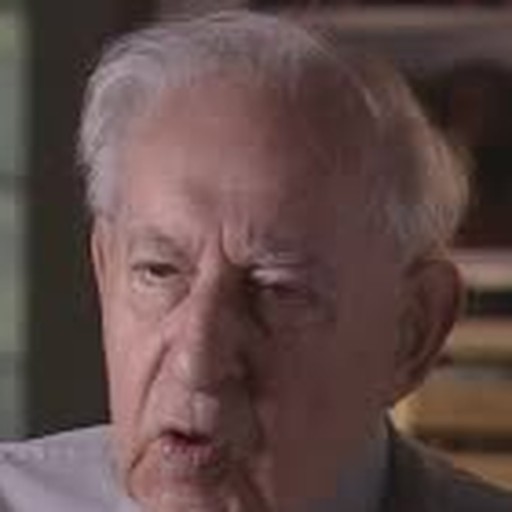
USHMM Flight and Rescue dataset: arrived in Japan 13 Feb 1941 (line 1684) - Oral history interview with Victor Erlich — United States Holocaust Memorial Museum, oral history interviews of the Flight and Rescue collection, RG-50.494.0010, recorded 1999. Linked; the Museum's still from the interview is shown on th…
He recorded an oral history for the United States Holocaust Memorial Museum's Flight and Rescue project in 1999, as Victor Erlich. It begins with him in Warsaw on 1 September 1939. The interview is linked here and its still is on the Testimonies page. - JDC Archives, New York, collection AR 33/44 file 53 (the Jewish Community of Kobe's returns to the JDC, 1941; Set I, item 00761) — Set I pp. 5–7 — "List… — "List of persons who left Japan for Shanghai in the month of July 1941", Nos. 1–15
He left Yokohama on the Heian Maru ("Heyan M.") on 17 July 1941, bound for Canada (the Jewish Community of Kobe's list of departures, July 1941 (JDC Archives, AR 33/44 file 53)). The list reads: "″ Wiktor". (Heian Maru ("Heyan M."), Yokohama, 17 July 1941, destination Canada.) - Yad Vashem Archives, Jerusalem — the card file of Jewish refugees from Poland who found refuge in various countries, 1939–1941
Yad Vashem's card file of Jewish refugees from Poland who found refuge in various countries, 1939–1941, has a card for Viktor Erlich, who was in Wilno during the war. The archive attaches it under its rule of 19 September 2026: the card file is a record of the refugees in Wilno, where the road through Sugihara's visas began; the full name occurs once on the register; and the card places the person in Wilno in 1939–41, on the road to Sugihara's visas. Credit: Yad Vashem Archives. - Oral history interview with Victor Erlich — United States Holocaust Memorial Museum, oral history interviews of the Flight and Rescue collection, RG-50.494.0010, recorded 1999. Linked; the Museum's still from the interview is shown on th…
In his oral history for the United States Holocaust Memorial Museum, Victor Erlich says he left Warsaw with his parents Henryk and Sophie Erlich on 6-7 September 1939 and reached Pinsk, where the Red Army arrived, and that his father was arrested at Brest-Litovsk on 1 October. He and his family went to Vilna and then Kaunas, where, as relatives of the Bund leader Henryk Erlich, they were sought by the NKVD. He says what saved the family at the Soviet exit office was that there were so many Erlichs in Warsaw that the officials did not know which family this was, and that an NKVD officer who tried to recruit him was refused. He says that he, his mother and his wife travelled together, by the Trans-Siberian Express in twelve days and nights, crossing Lake Baikal, and that the crossing from Vladivostok to Japan was very stormy. In Japan the three of them nearly stayed, because the American consulates stopped granting visitor visas to people with close relatives under German or Soviet rule, so they obtained Canadian visas through the Polish ambassador in Tokyo and sailed in August 1941. He says he lived near Yokohama, saw Tokyo several times and Kobe only briefly, and visited the Kamakura Buddha. In Canada they landed at Vancouver and spent a year in Montreal. He reached New York with his mother and his wife in autumn 1942 on regular immigration visas, was drafted into the American army in 1943, fought as an infantryman in eastern France from November 1944, was seriously wounded in March 1945 and treated at Dijon, and enrolled at Columbia in September 1945. He describes his father, Henryk Erlich, as arrested by the Soviet police on 1 October 1939 and, according to Soviet archive papers found by a cousin, dead by suicide in his cell in May 1942, and his grandfather, the historian Simon Dubnov, as shot by a Latvian in Riga in December 1941. - Heian Maru, Yokohama to Seattle, arrived 31 July 1941, list ? (National Archives, M1383 roll 263, frame 613, NAID 553890806)
Victor Erlich is on a line of the Heian Maru's list of alien passengers, sailing from Yokohama and arriving at Seattle on 31 July 1941: 26 years old, journalist, born in Petrograd. The name is rare on the register and the age agrees with it, on a sailing from Japan in the months the refugees crossed, so the archive takes this to be the same person. (US National Archives, Record Group 85, passenger and crew lists of vessels arriving at Seattle, Washington.) - The HEIAN, arriving at Seattle in 1941: list or manifest of alien passengers, the sheet that names Jakub Kaliski — US National Archives, Record Group 85 (Immigration and Naturalization Service), Passenger and Crew Lists of Vessels Arrivi…