Blond Szejna
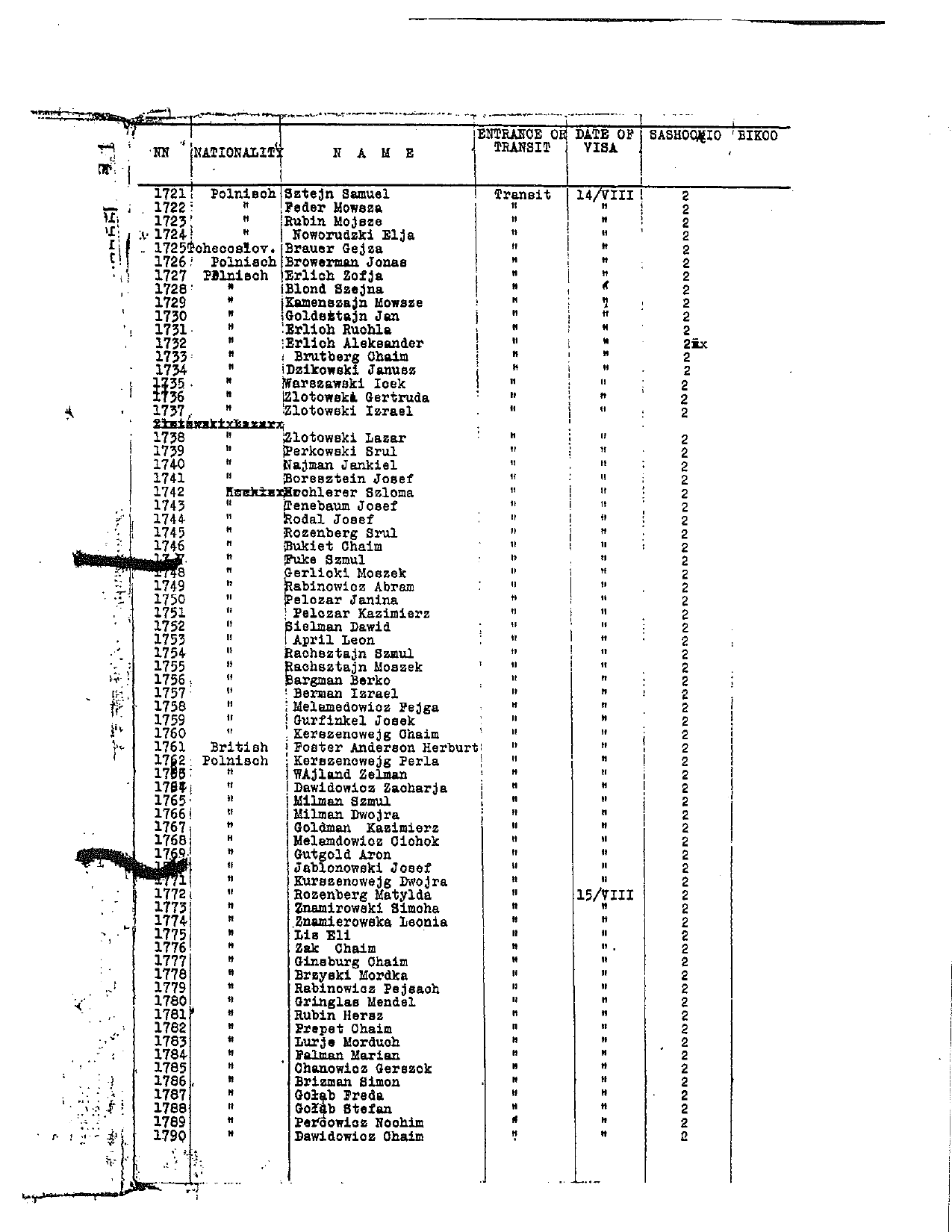
Blond Szejna received transit visa no. 1728 at the Japanese consulate in Kaunas on 14 August 1940. The register records journalist, aged 53.
Documents
| Name | Szejna Blond |
|---|---|
| Citizenship | Polnisch [Polish] |
| Visa | Transit |
| Issued | 14 Aug 1940 · arrived in Japan 13 Feb 1941 |
| Line | 1728 |
What the register records
- Nationality as recorded
- Polnisch
- Age in 1940
- 53
- Occupation
- Journalist
The journey
Reached Japan; aided by the Polish ambassador Tadeusz Romer; registered in Kobe for USA.
What is known
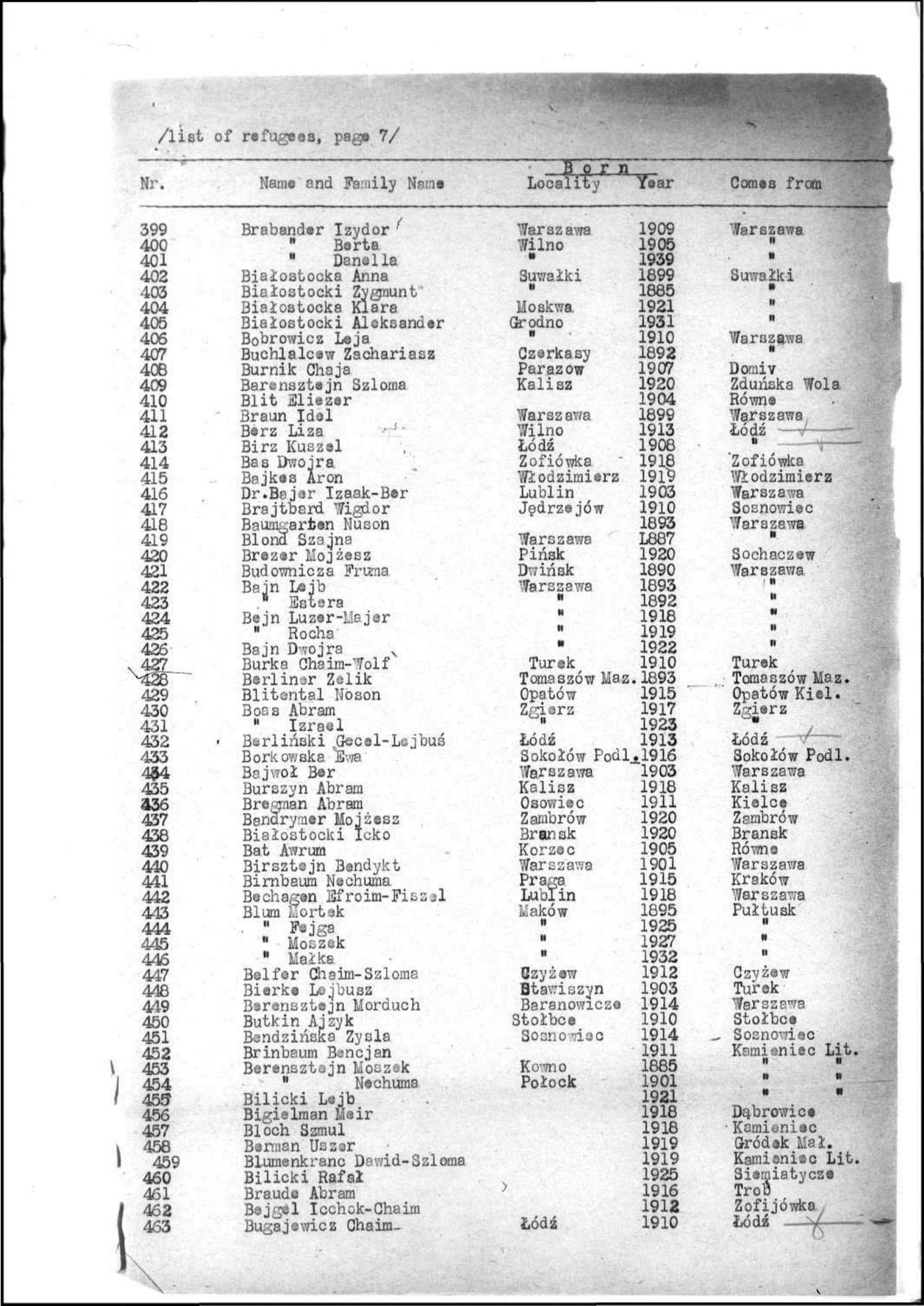
Szejna Blond, a journalist born at Vilna in 1887, received Sugihara's transit visa at Kaunas on 14 August 1940; the typed line has lost the first letter of her given name. The 1940 Vilna refugee list has a Blond Szajna, born 1887, as coming from Warsaw, where both Kobe lists give Vilnius as her birthplace, and Yad Vashem's card file of Polish refugees places a Szejna Blond in Wilno. Kobe's Jewish community registered her as a journalist of fifty-four who arrived in Japan from Vilnius on 13 February 1941, and its list of refugees and their relatives abroad names an uncle in New York and a cousin in Pittsburgh. She reached San Francisco on 10 April 1941 on the Kamakura Maru from Yokohama: the passenger list calls her a widow born in Wilno, travelling on an American visitor's visa to a relative in New York. The Forverts of 17 April 1941 reported that Szejna, called Dina, known in Poland as one of the most brilliant women speakers of the Jewish socialist movement, had reached New York by way of Siberia and Japan with the help of the Jewish Labor Committee. That is the last record the archive holds.
Where this comes from
- The Kobe relatives list — refugees at Kobe in 1941 recorded with their relatives abroad. Seventy-six pages in numbered sheets (LIST No. 7, No. 16 and others), each line giving a name, age, birthplace, occupation and citizenship, and then…
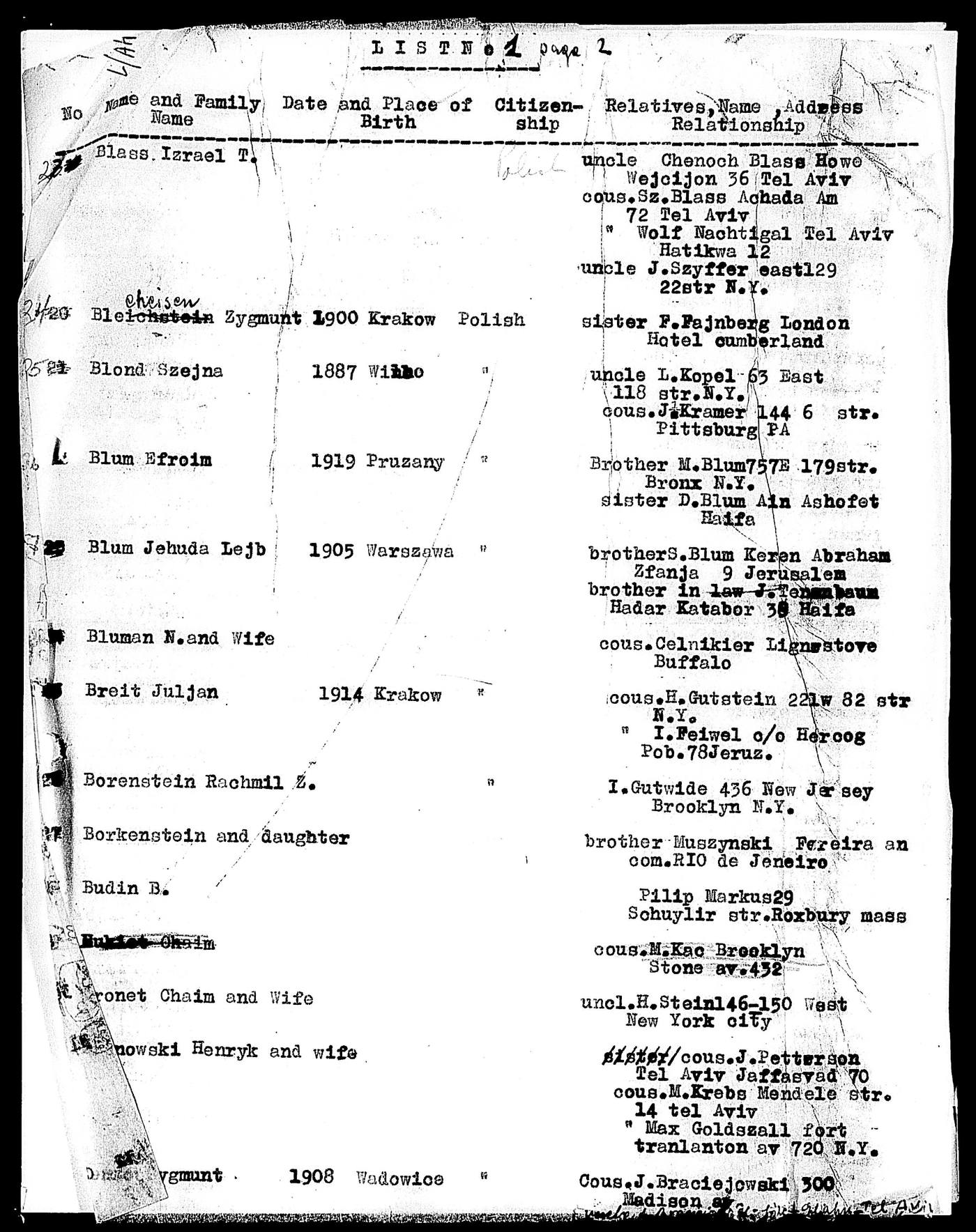
Entry 21 of the Kobe community's list of refugees and their relatives abroad: born 1887 at Vilnius (Wilno), Polish; relatives abroad: an uncle, L. Kopel, 63 East 118th Street, New York; a cousin, J. Kramer, 144 6th Street, Pittsburgh, Pennsylvania. - The JEWCOM register — the refugee register kept by the Refugee Committee of the Jewish Community of Kobe (Ashkenazim) at No. 6 Yamamoto-dori, 1-chome, whose cable address was 'JEWCOM Kobe'. Eighty-four pages on the committee's own printe…
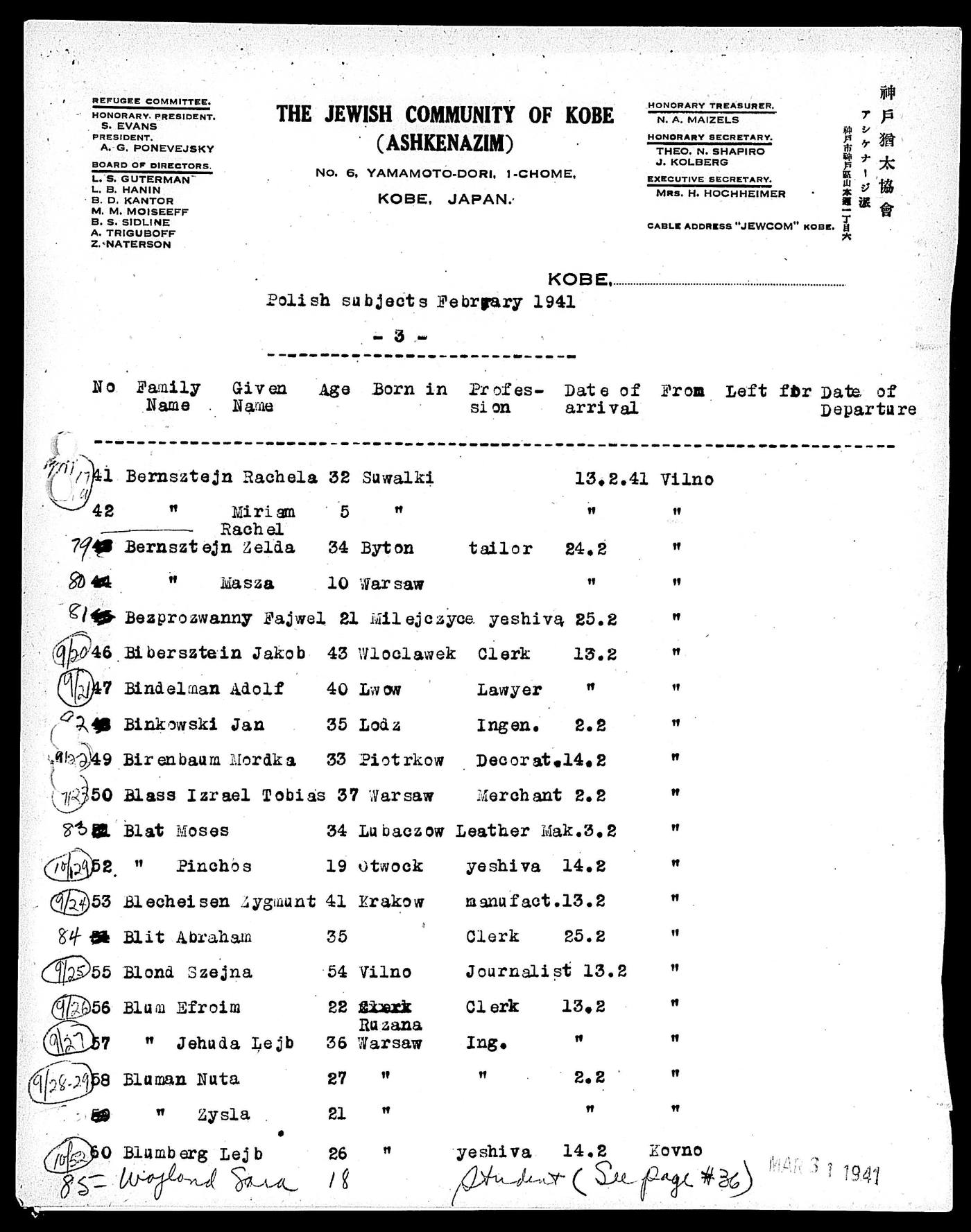
Entry 55 of the Kobe Jewish Community's refugee register: aged 54, born at Vilnius (Vilno), a journalist, who arrived in Japan from Vilnius on 13 February 1941. - United States Holocaust Memorial Museum, Holocaust Survivors and Victims Database — the Flight and Rescue electronic dataset (source 20725): USHMM's own transcription of the Kaunas register, 2,140 persons with citizenship, visa type, iss…
USHMM Flight and Rescue dataset: arrived in Japan 13 Feb 1941 (line 1728) - "California, San Francisco, Passenger Lists, 1893-1953", FamilySearch — index entry for Szejna or Soja Blond, 1941: born about 1887, Poland. Digitised from NARA microfilm publication M1410 (passenger lists of vessels arriving at San Fran…
FamilySearch's index of the San Francisco passenger lists, read by the archive on 20 September 2026, has Szejna or Soja Blond, born about 1887 in Poland, arriving at San Francisco in 1941. The register's compiled line gives 1887, and the two agree. The name occurs once on the register, and a Polish-born passenger landing at San Francisco in 1941 fits the route through Japan, so the entry is taken as this person's under the archive's rule of 19 September 2026 for records from the route. - Manifest of alien passengers, SS Kamakura Maru, sailing from Yokohama March 27th 1941, arrived San Francisco April 10th 1941 (US National Archives, M1410, film 369; read on FamilySearch's copy)
She reached San Francisco on 10 April 1941 on the Kamakura Maru from Yokohama, a widow born in Wilno, on an American visitor's visa, going to B. Hofman at 175 East Broadway, New York, according to the passenger list held by the National Archives (FamilySearch's copy). - Forverts (New York), 17 April 1941 (National Library of Israel, Historical Jewish Press)
Szejna (Dina) Blond, known in Poland as one of the most brilliant women speakers of the Jewish socialist movement, reached New York in April 1941 by way of Siberia and Japan with the help of the Jewish Labor Committee, as the Forverts reported on 17 April 1941 (National Library of Israel, Historical Jewish Press). - Yad Vashem Archives, Jerusalem — the card file of Jewish refugees from Poland who found refuge in various countries, 1939–1941
Yad Vashem's card file of Jewish refugees from Poland who found refuge in various countries, 1939–1941, has a card for Szejna Blond, who was in Wilno during the war. The archive attaches it under its rule of 19 September 2026: the card file is a record of the refugees in Wilno, where the road through Sugihara's visas began; the full name occurs once on the register; and the card places the person in Wilno in 1939–41, on the road to Sugihara's visas. Credit: Yad Vashem Archives. - List of Refugees, Vilna, 1940 — JDC Archives, New York, collection AR 33/44, file 00876. The contemporary register of Polish Jewish refugees in Lithuania, running to more than nine thousand numbered entries; the fullest independent check…
The 1940 Vilna refugee list has, at entry 419, Blond Szajna, born 1887, who came from Warsaw; the year agrees exactly with the age the register gives. The list writes Warsaw as her birthplace where both Kobe lists write Vilnius; the two records disagree on the town and agree on the year.