Chil Benjamin Fiszof
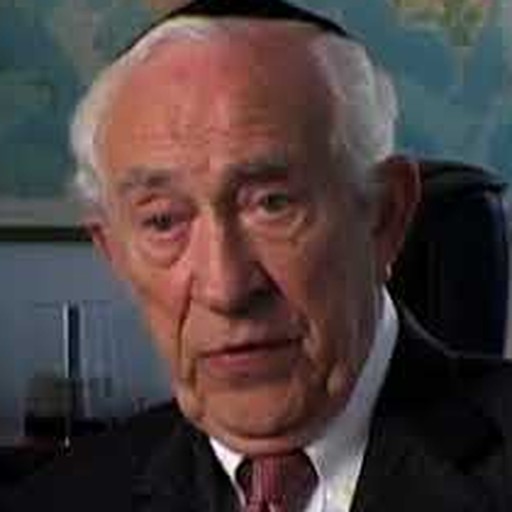
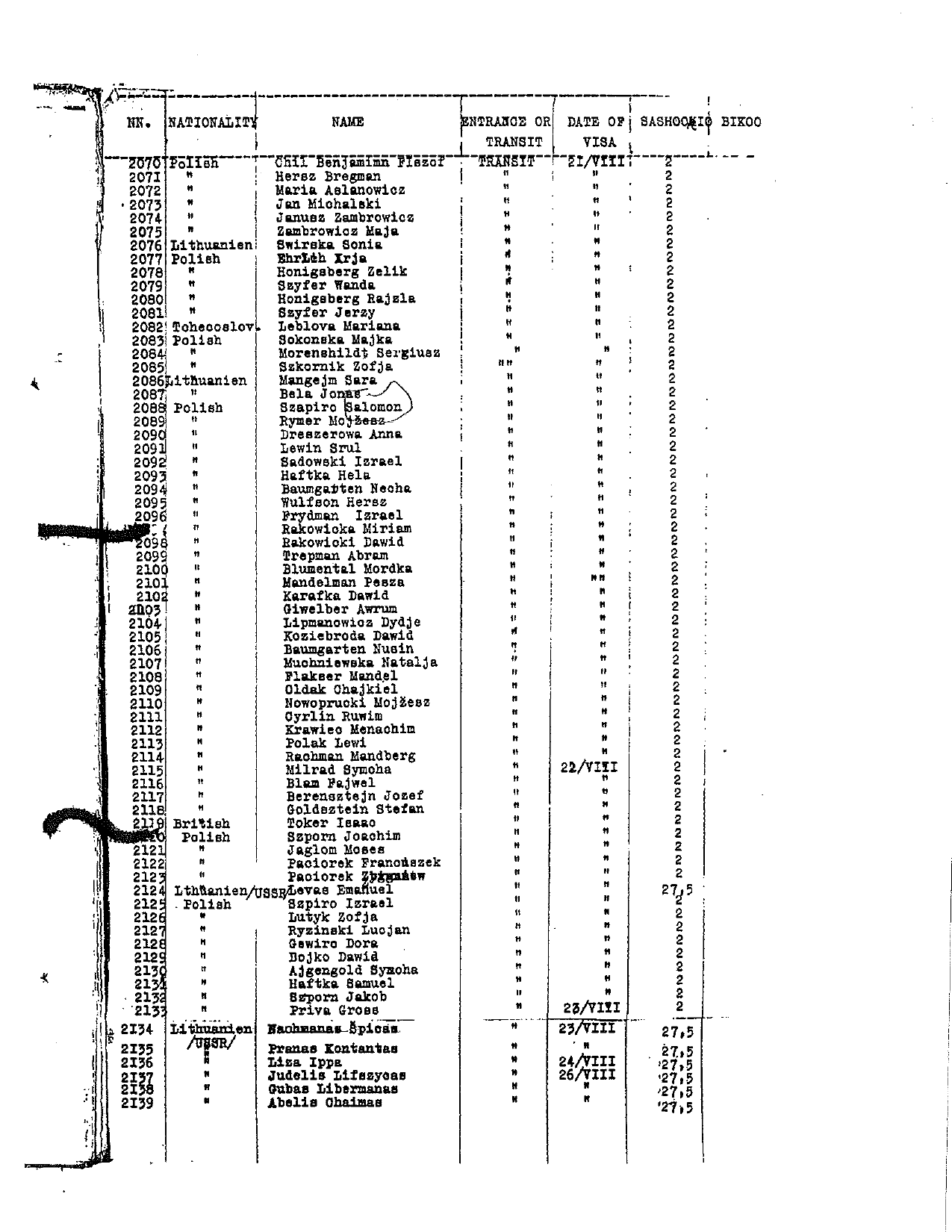
Chil Benjamin Fiszof received transit visa no. 2070 at the Japanese consulate in Kaunas on 21 August 1940. The register records rabbinical student - telshe yeshiva, aged 16.
What the register records
- Nationality as recorded
- Polish
- Age in 1940
- 16
- Occupation
- Rabbinical Student - Telshe Yeshiva
The journey
Reached Japan; reached Shanghai; registered in Kobe for USA.
What is known
Born into a family of Gerrer chasidim in Wloczewa, Poland (family later moved to Lodz in 1925), Benny Fishoff traveled as a teenager to live with his grandparents in Vilna at the start of WWII. He received a lifesaving Sugihara visa to Japan and eventually made it to Shanghai along with the Mirrer Yeshiva bochurim, where he connected with the Amshinover Rebbe. After the war he settled in New York (Brooklyn, then Forest Hills, Queens), became a successful electronics importer/exporter and prominent philanthropist, and served as longtime chairman of Agudath Israel of America. He died September 20, 2021 at age 97.
Benjamin Fishoff is described as a 'Sugihara Survivor' interviewed in the documentary, one of the Jewish refugees saved by Chiune Sugihara's transit visas.
Benny, then a teenager, received a lifesaving visa to Japan due to the benevolence of Chiune Sugihara, the Japanese Consul to Lithuania. Reb Benny eventually made it to Shanghai along with the Mirrer Yeshiva bochurim, where he developed a connection to the Amshinover Rebbe. Reb Benny's name appears on the last page of these visas, as it was issued just moments before the program expired. In May of 2014, Reb Benny stood with Rabbi Yisroel Meir Lau and Assembly Member Dov Hikind at Temple Beth El and awarded Ambassador Sumio Kusaka, the Consulate General to Japan, a plaque for saving 2,139 Jewish souls.
Where this comes from
- The Kobe relatives list — refugees at Kobe in 1941 recorded with their relatives abroad. Seventy-six pages in numbered sheets (LIST No. 7, No. 16 and others), each line giving a name, age, birthplace, occupation and citizenship, and then…
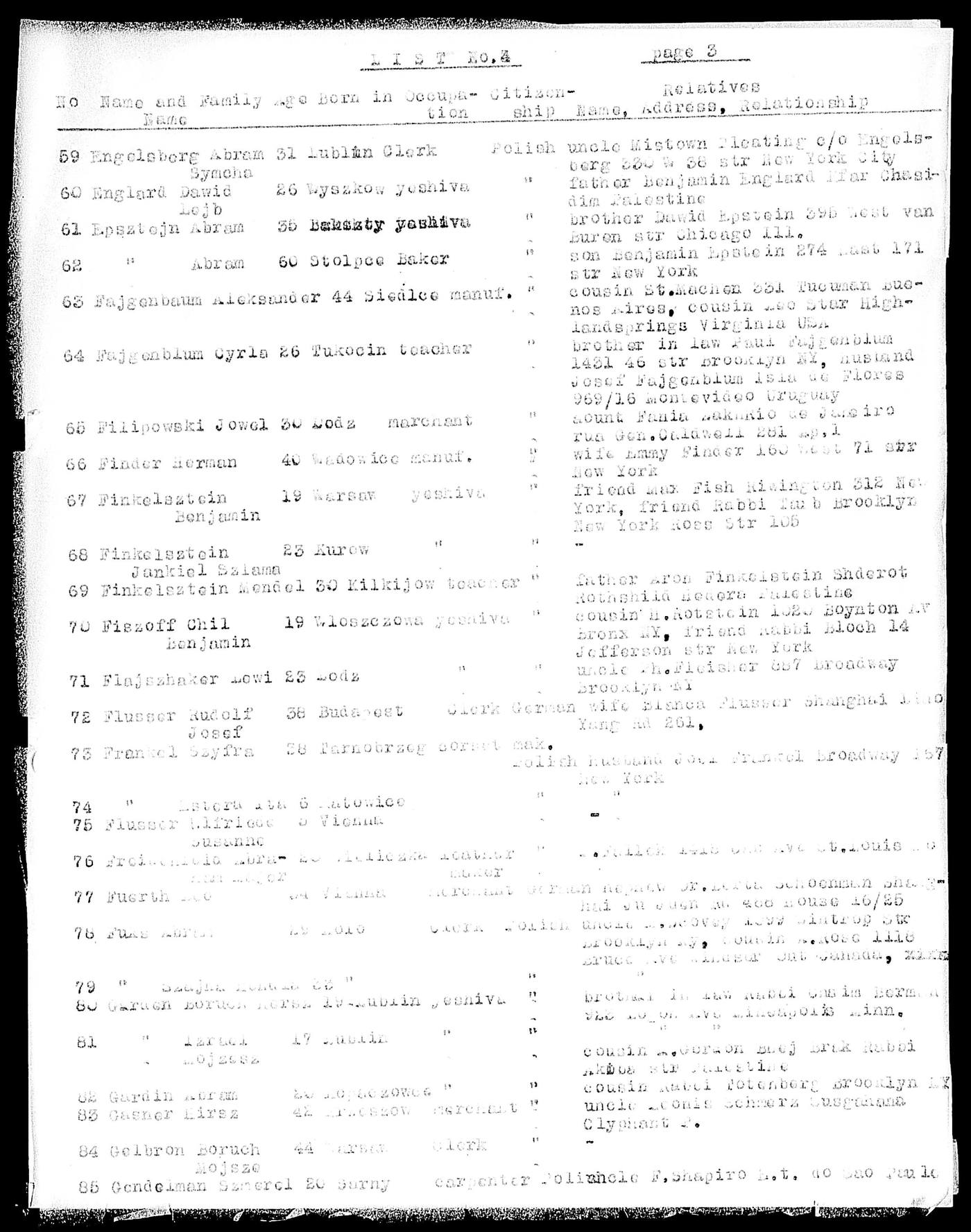
Entry 70 of the Kobe community's list of refugees and their relatives abroad: aged 19, born at Wloszczowa, a yeshiva student; relatives abroad: a cousin, H. Rotstein, 1020 Boynton Avenue, Bronx, New York; a friend, Rabbi Bloch, 14 Jefferson Street, New York. - The list of seventy-four — Netherlands Legation, Tokyo, 18 March 1941. On the Legation's letterhead (Gezantschap der Nederlanden), certifying 'that the undermentioned persons all of Polish nationality do not need a Netherlands visa in or…
Named at position 20 of seventy-four on the Netherlands Legation's certificate of 18 March 1941 — the list of the people who reached Tsuruga on Sugihara's transit visas without a Curaçao endorsement, were refused permission to land, and whose ship was turned back towards Vladivostok. The Legation typed the name as "Fiszow Chil". A pencilled note beside it gives this register number, which is how the two records are joined. A later hand adds the name he is known by: Benjamin Fishoff. - "California, San Francisco, Passenger Lists, 1893-1953", FamilySearch — index entry for Chil-Benjamin Fiszoff, 1947: born about 1923, Poland. Digitised from NARA microfilm publication M1410 (passenger lists of vessels arriving at San Fra…
FamilySearch's index of the San Francisco passenger lists, read by the archive on 20 September 2026, has Chil-Benjamin Fiszoff, born about 1923 in Poland, arriving at San Francisco in 1947 on the Marine Lynx. The register's compiled line gives 1924, and the two are 1 year apart, and the name occurs once on the register. The ship's manifest heading says she sailed from Shanghai, and a passenger born in Poland landing at San Francisco in 1947 from Shanghai is the route's end: the refugees who waited out the war there. So the entry is taken as this person's under the archive's rule of 19 September 2026 for records from the route. The sheet is NARA microfilm publication M1410, film 387, image 234, read by the archive on 20 September 2026. - Benjamin Fishoff, filmed interview, 2007 — on YouTube under the title 'BenjamenFishoffInt2007'. Pointed out to the archive by Hans de Vries, 29 September 2026.
In a filmed interview recorded in 2007, Benjamin Fishoff said he was born in a small town near Łódź but grew up in Łódź, and went to a school that taught secular subjects as well as Jewish ones. After the Germans came in September 1939 he crossed the river into the Soviet zone alone, meaning to send word for his parents to follow; he never managed to reach them again. From Białystok he went with a group of Chabad students to Vilna, smuggling across the Lithuanian border in December 1939 after being caught and sent back several times, and at Passover 1940 he was placed at the Telshe yeshiva (from about two to eight minutes in). Fishoff recalled that in the summer of 1940 a fellow Telshe student, Nathan Gutwirth, a Dutch citizen, was told by the Dutch consul that no visa was needed for Curaçao, and then asked Sugihara for a transit visa to Japan; the news spread through the yeshivas. Fishoff said he learned of it too late to get a Dutch note himself, and that a head of the Mir yeshiva put his name on the list of students for whom Sugihara wrote visas. He remembered his visa number as about 2120, near the end of the 2,139 (about eight to fourteen minutes in). Fishoff described the journey to Japan in his 2007 interview: an exit visa from the Soviet authorities, tickets that had to be bought in dollars (his group got them cheaply by sending a Russian soldier to buy them), eleven days by train from Moscow to Vladivostok, then a small boat to Japan. At the Japanese port, he said, the immigration officer refused to let those with only transit visas land, and seventy-two of them were sent back towards Russia, where they feared they would be sent to Siberia. The Jewish community in Japan went to the Dutch consul, who gave the group Curaçao papers, and the ship turned back (about seventeen to twenty-four minutes in). The Netherlands Legation's certificate of 18 March 1941 lists seventy-four names, among them his. In Kobe, Fishoff said, the Jewish community and the Japanese authorities helped the newcomers; the refugees were put in rented houses of twenty or thirty people, were paid about a yen a day, and argued over whether to keep Saturday or Sunday as the day of rest. Matzah for Passover 1941 came from the United States. Around August 1941, he said, all foreigners were told to leave for Shanghai (about twenty-seven to thirty-three minutes in). In Shanghai Fishoff said most of the refugees settled in Hongkou, but that he himself lived in the French Concession. He described the Mir yeshiva studying in a large synagogue near the business district, the 1943 order that confined the stateless refugees to the ghetto, and the end of the war; the emigration that followed, he said, brought most of them to the United States, some as rabbis and some as students and teachers (about thirty-nine to fifty-three minutes in). Near the end of the interview Fishoff said that those saved had left their families behind, and that his own parents, three sisters, two brothers and hundreds of relatives did not survive (about one hour six minutes in). - UNRRA China Office, S-1132-0000-0181, Mizrachi members list and the United Board of Rabbis' birth-data pages, Shanghai 1945–46 (UN Archives, AG-018-001)
The United Board of Rabbis and Rabbinical Colleges in Shanghai listed him among its members after the war, born in 1922 in Wleszczowa. (United Nations Archives, UNRRA China Office records.) - List of members of the United Board of Rabbis and Rabbinical Colleges, Shanghai (United States Holocaust Memorial Museum, Holocaust Survivors and Victims Database, list 48661)
Chil Fiszoff is named on the list of members of the United Board of Rabbis and Rabbinical Colleges in Shanghai, indexed by the United States Holocaust Memorial Museum. The name occurs once on the register; the Board was the body of the Polish rabbis and yeshiva students who reached Shanghai from Kobe in 1941, and their families, the route the register records for this line. - Petition for naturalization No. 477326 of Benjamin Chil Fishoff, also known as Chil Benjamin Fiszof, US District Court for the Eastern District of New York, 1951 (NARA; read on FamilySearch, "New York, U.S. District and Circuit Court Nat…
Chil Benjamin Fiszoff became Benjamin Chil Fishoff, a rabbi in Brooklyn. His petition for naturalization, filed in the Eastern District of New York in 1951, gives his birth as 14 December 1922 at Włoszczowa, his occupation as rabbi, his marriage at Brooklyn in August 1949, and his lawful entry for permanent residence at Niagara Falls, New York, over the Rainbow Bridge from Canada, on 28 October 1947, under the name Chil Benjamin Fiszof; he was naturalised on 13 February 1951. The birth date and town agree with the Kobe community's list for this line, and the name occurs once on the register. (FamilySearch's copy of the National Archives' court records; its index also has him passing through Honolulu by air in 1948.) - "California, San Francisco, Passenger Lists, 1893-1953", FamilySearch — index entry for Chil-Benjamin Fiszoff, 1947: born about 1923, Poland. Digitised from NARA microfilm publication M1410 (passenger lists of vessels arriving at San Fra…
The manifest sheet itself has him as Fiszoff Chil-Benjamin, aged 24, single, a student, Polish, Hebrew, born at Łódź in Poland, last permanent residence Shanghai, travelling on a non-quota immigration visa, No. 646 under section 4(a), issued at Shanghai on 20 September 1946, and a Polish passport No. 015844; the inspector's note has him admitted at San Francisco on 30 January 1947. The visa was the kind issued to students and ministers of religion, which fits a yeshiva student who became a rabbi; his later petition records a second, permanent entry from Canada in October 1947. - La-karov ve-la-rachok, 28 March 1946 — the Far Eastern Palestine Committee's list of Jewish refugees in Shanghai (National Library of Israel, Historical Jewish Press)
The Far Eastern Palestine Committee's list of Jewish refugees in Shanghai, printed by the Jewish Agency Search Bureau's bulletin La-karov ve-la-rachok on 28 March 1946, lists Chil Benjamin Fiszoff: born 1922 at Wloszczowa, a yeshiva student, arrived in 1941 from Lodz; the year, the town and the trade agree with the Kobe community's list of refugees and their relatives (National Library of Israel, Historical Jewish Press). - Mishpacha, "Angel of Peace" by Yisroel Besser, issue 880, 6 October 2021
Yisroel Besser's profile of him in Mishpacha, 6 October 2021, says his father, Dov Ber, a dried-fruit importer and Gerrer chasid, moved the family from Włoszczowa to Łódź; that he left Łódź in late 1939, reached Vilna, travelled to Japan on a Sugihara transit visa, and spent about five years in Shanghai, where he learned English and currency exchange; and that he reached San Francisco in 1947. The same profile places him briefly with the Telz students in 1940 and with the Lublin yeshiva group in Shanghai, where the archive's other sources say Mir; the page records both. - Mishpacha, "From Benny, With Love" by Yisroel Besser, issue 985, 8 November 2023
Yisroel Besser, writing in Mishpacha on 8 November 2023, says he wrote down his story for his grandchildren in 2016, and that the memoir was published after his death as B'Ahavah, Benny (ArtScroll, 2023); the article puts his marriage in 1949, which agrees with his naturalization petition. - ArtScroll Mesorah, B'Ahavah, Benny: Reb Yechiel Benzion Fishoff, by Yisroel Besser, 2023 (352 pp., ISBN 9781422639511)
A book about his life, B'Ahavah, Benny, by Yisroel Besser, was published by ArtScroll in 2023; it follows him from Łódź to Shanghai to New York. - BoroPark24, "Reb Yechiel Benzion (Benny) Fishoff z"l, Pillar of American Torah Jewry", 20 September 2021
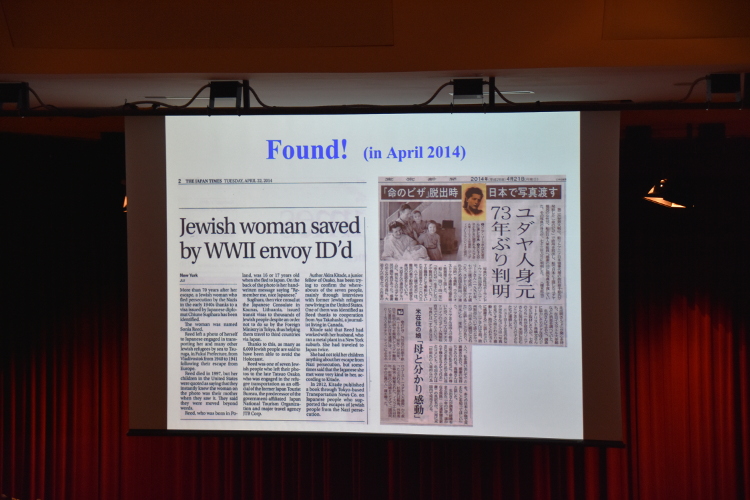
BoroPark24's notice of 20 September 2021 announced the death of Reb Yechiel Benzion (Benny) Fishoff, said he reached Shanghai from Łódź, and named him a longtime leader of Agudath Israel and chairman of Metropolitan Bank. - Flyer for Junichi Kajioka's short documentary 'Sugihara Survivors: Jewish and Japanese, Past and Future' (25 minutes, Japan/UK, 2017), with notes on Akira Kitade's search for the people in the Japan Tourist Bureau album; five pages.
- Benny Fishoff Z”l: Unassuming Forest Hills Philanthropist Was ‘Ambassador For Torah Jewry’
- Honolulu Festival 2017 report, 'Inspiring Story of Chiune Sugihara — Visas for Life' (Kitade keynote,… — Amakusa Maru passenger sent back to Vladivostok for lack of papers, later admitted via Kobe community's help; five sons, 28 grandsons
