Perla Frankel
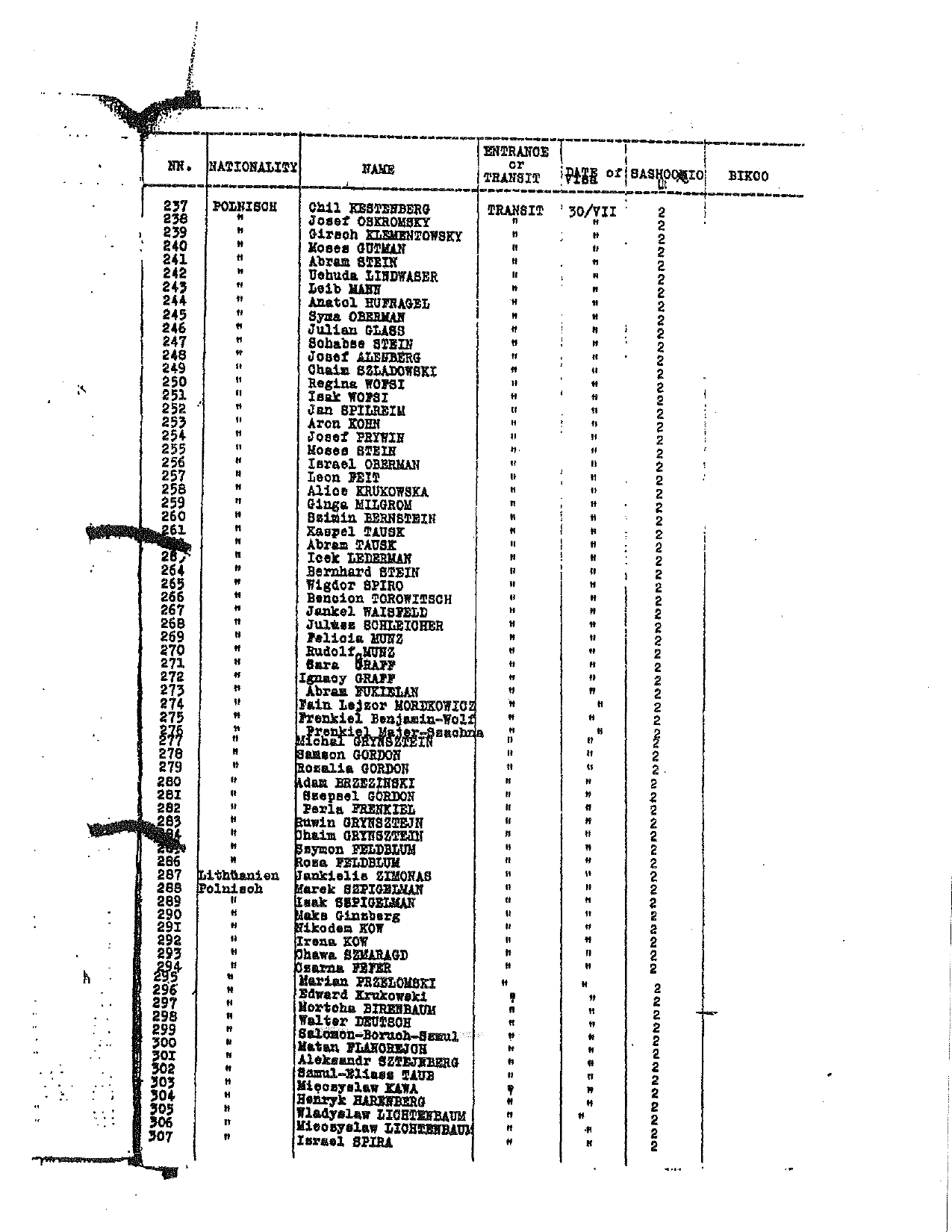
Perla Frankel received transit visa no. 282 at the Japanese consulate in Kaunas on 30 July 1940. Aged 24 in 1940.
Documents
| Name | Perla Frenkiel |
|---|---|
| Citizenship | Polnisch [Polish] |
| Visa | Transit |
| Issued | 30 Jul 1940 · arrived in Japan 24 Feb 1941 |
| Line | 282 |
What the register records
- Nationality as recorded
- Polnisch
- Age in 1940
- 24
- Family, per the Kitade-Bluman list
- wife of #275, son Berl (3)
The journey
Reached Japan; registered in Kobe for New Zealand.
Travelled with, and never given a number
- Berl — son, aged 3
The register recorded visa holders. It did not reliably record the wives and children who travelled on somebody else’s visa, so these people have no entry of their own and cannot be searched for. Where the archive has recovered a name, it is here.
What is known
Perla Frankel, a survivor saved by Sugihara visas, recalled rampant anti-Semitism in Poznan around 1933 with signs stating 'No dogs or Jews allowed' at cafes. Her family acted quickly, selling their car and renting a bus to leave Krakow for Lublin just after war began on September 2, 1939. She later escaped through the Soviet Union via the Trans-Siberian Railway to Vladivostok, boarding the Amakusa Maru to reach Tsuruga in Japan, fearing being sent to Siberia under Russian rule.
At that time, we didn't think we would be killed. Nobody thought that we would be killed, or that the Germans could be so cruel. […] We only thought at worst we might be taken to work camps. We were afraid of being sent to Siberia, or being under Russian rule, which could mean being thrown into a cell to wither away for many years. The most difficult thing about leaving Lithuania was obtaining an exit visa from the Russians. The Russians did not want their people to leave the country and they had the right to refuse it.
Where this comes from
- List of Refugees, Vilna, 1940 — JDC Archives, New York, collection AR 33/44, file 00876. The contemporary register of Polish Jewish refugees in Lithuania, running to more than nine thousand numbered entries; the fullest independent check…
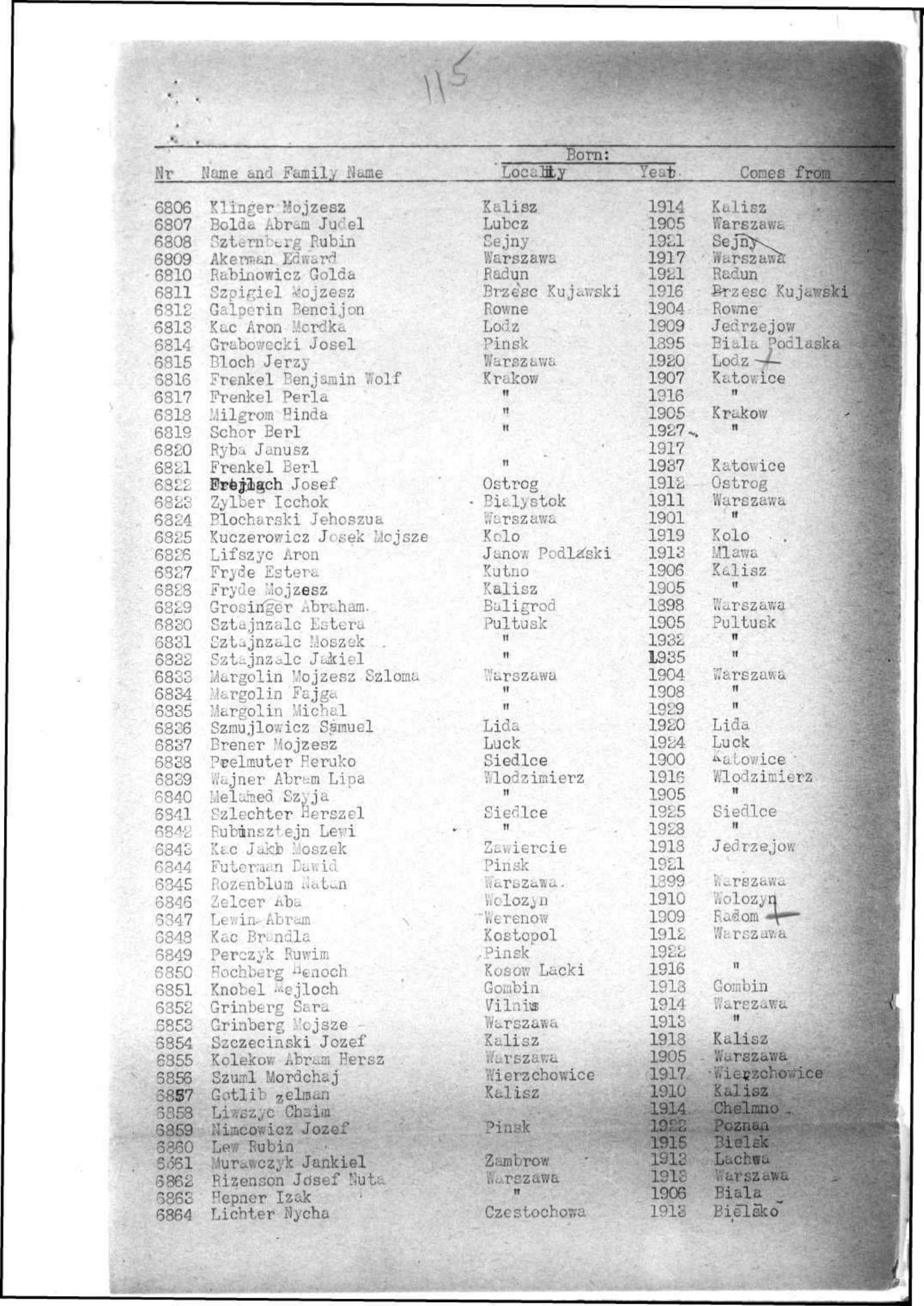
The 1940 Vilna refugee list has, at entry 6817, Perla Frenkel, born 1916 at Krakow, who came from Katowice; the year agrees with the register's compiled age, and her husband Benjamin Wolf, also on the register (No. 275), stands just above her on the list. - The JEWCOM register — the refugee register kept by the Refugee Committee of the Jewish Community of Kobe (Ashkenazim) at No. 6 Yamamoto-dori, 1-chome, whose cable address was 'JEWCOM Kobe'. Eighty-four pages on the committee's own printe…
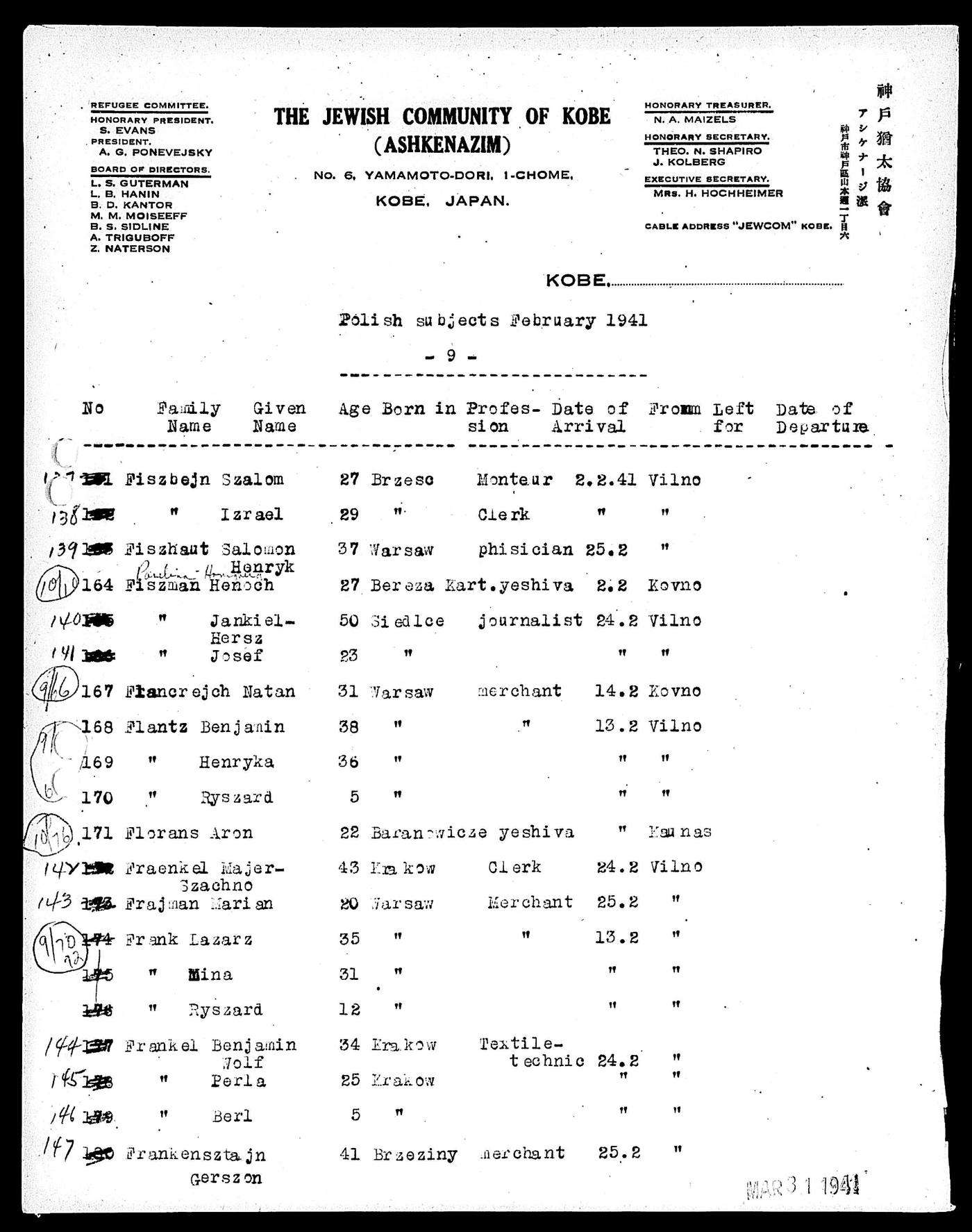
Entry 145 of the Kobe Jewish Community's refugee register: aged 25, born at Krakow. - "List of persons arriving on route to New Zealand" — the arrival roster for the sailing from Japan, September 1941: 33 typed names, from Dr George Bluman’s own marked-up cop… — September 1941, not July; he had misread his own handwriting.
Named on the list of persons arriving on route to New Zealand, sailing from Japan in 1941. The register spells it Frenkiel. - United States Holocaust Memorial Museum, Holocaust Survivors and Victims Database — the Flight and Rescue electronic dataset (source 20725): USHMM's own transcription of the Kaunas register, 2,140 persons with citizenship, visa type, iss…
USHMM Flight and Rescue dataset: arrived in Japan 24 Feb 1941 (line 282) - Takayoshi Iwata, "Kobe and Jewish Refugees" (神戸とユダヤ難民), Kobe City history bulletin no. 26, March 2017 — English translation published by the City of Kobe
She crossed from Vladivostok on the Amakusa Maru and spent about six months in Kobe, from February to August 1941, with her husband, their small son and her brother Berl. They lived in a communal house at 1-85 Kitano-chō, shared with the Baruch family. She remembered the community's allowance as 'much appreciated'. (Takayoshi Iwata, 'Kobe and Jewish Refugees', Kobe City history bulletin no. 26 (2017), English translation published by the City of Kobe, drawing on her memoir.) - Takayoshi Iwata, "Kobe and Jewish Refugees" (神戸とユダヤ難民), Kobe City history bulletin no. 26, March 2017 — English translation published by the City of Kobe