Zielonka Berek
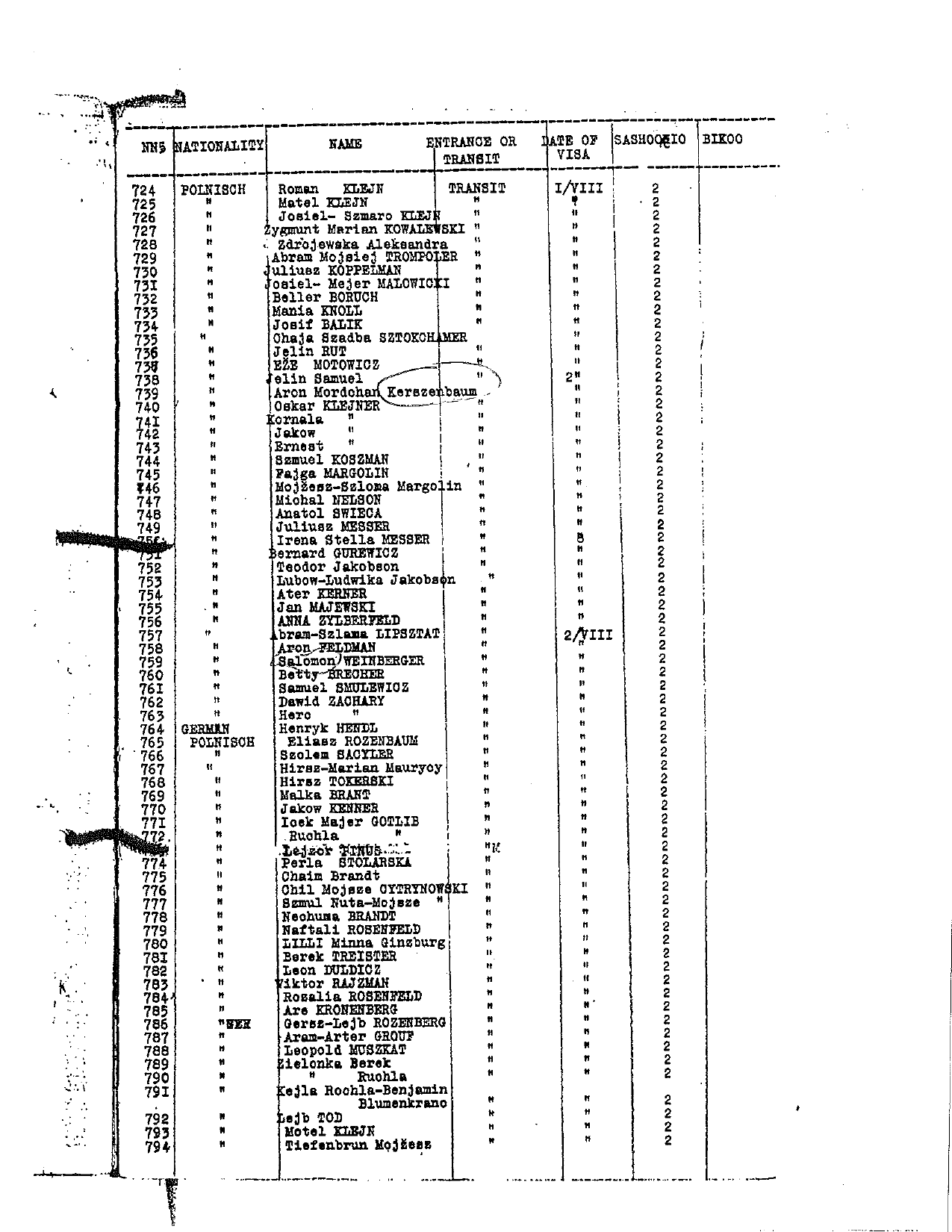
Zielonka Berek received transit visa no. 789 at the Japanese consulate in Kaunas on 2 August 1940. The register records flourmiller, aged 35.
What the register records
- Nationality as recorded
- Polnisch
- Age in 1940
- 35
- Occupation
- Flourmiller
- Family, per the Kitade-Bluman list
- husband of #790, daughter Jochwet (3)
The journey
Reached Japan; aided by the Polish ambassador Tadeusz Romer; registered in Kobe for USA.
Travelled with, and never given a number
- Jochwet — daughter, aged 3
The register recorded visa holders. It did not reliably record the wives and children who travelled on somebody else’s visa, so these people have no entry of their own and cannot be searched for. Where the archive has recovered a name, it is here.
What is known
The parents of American businessman Sam Zell (born Shmuel Zielonka), Berek (later Bernard) and Ruchla (later Rochelle) Zielonka, were Polish Jews who fled Poland four months before Sam's birth to escape the Nazi invasion. They immigrated to the United States with their young daughter Julie via Russia and Tokyo on transit visas supplied by Chiune Sugihara, pretending to be tourists at the Bolshoi Ballet to avoid standing out. They settled in Seattle before moving to Albany Park, Chicago, where Bernard became a wholesale jeweler and successful investor. [Archive note, 2026-07-28: the source names the travelling daughter as Leah. Corrected to Julie — per Leah Zell's own account (Liberties Journal, 24 Jul 2026) she was born in the United States after the escape, and the child on the journey was her sister, then about three.]
Berek (Bernard) Zielonka-Zell, a businessman from Sosnowiec, fled to Lithuania in 1939 with his wife Ruchla and their small daughter. On visas Nos.789-790 (2 Aug 1940) the family crossed on the Trans-Siberian to Vladivostok and Japan, reaching the United States in May 1941 — four months before their son, the future Chicago real-estate magnate Sam Zell, was born. Decades later, in April 1989, the two widows — Mrs. Zell and Yukiko Sugihara — met at O'Hare and shared an evening of Eastern European dishes over Lake Michigan, an encounter Yukiko recorded in the prologue of her memoir. Daughter Leah Zell has written about reintroducing nuance into both fathers' hero stories.
The Zielonka family escaped the Germans from Sosnowiec, a Polish town near Auschwitz, with three-year-old daughter Julie. After receiving a Sugihara visa, they traveled via Vladivostok to Japan and eventually settled in Chicago. Once in the United States, and after their son Sam was born, they changed their name to Zell; Sam Zell became a renowned real estate entrepreneur.
on transit visas supplied by Chiune Sugihara, a Japanese diplomat in Vilnius who saved thousands of Jews pretended to be tourists at the Bolshoi Ballet so as not to stand out His parents, Ruchla, later Rochelle, and Berek, later Bernard, Zielonka, were Jews who immigrated from Poland four months before his birth to escape the Invasion of Poland by the Nazis.
Rochelle and Berek Zielonka and their daughter Julie, who was three-years old at the time. The Zielonkas had escaped the Germans by the skin of their teeth from Sosnowiec, a small Polish town 40 miles from Auschwitz. It wasn't until they were United States residents and their son Sam was born that the Zielonkas changed their name to Zell.
Where this comes from
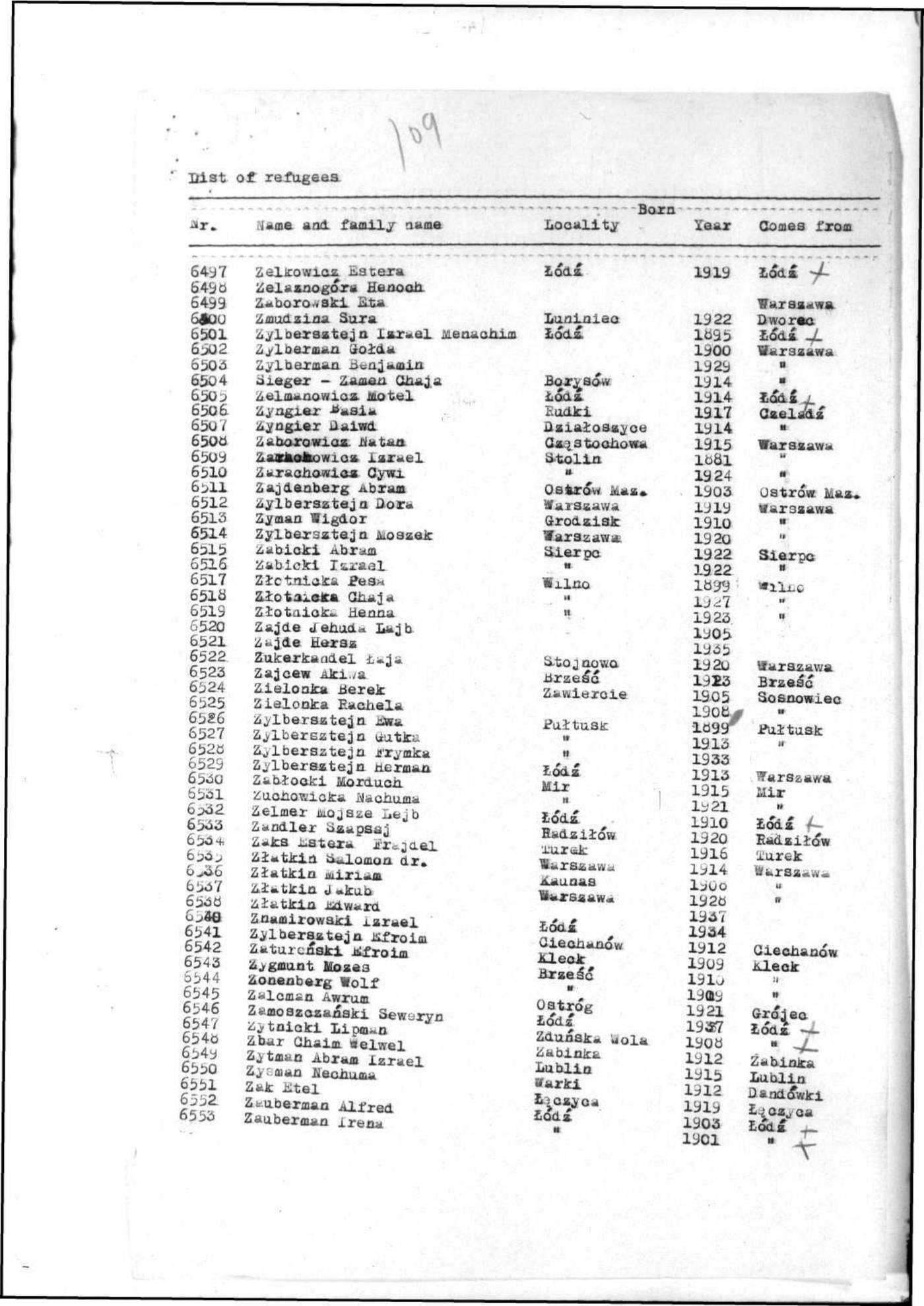
- List of Refugees, Vilna, 1940 — JDC Archives, New York, collection AR 33/44, file 00876. The contemporary register of Polish Jewish refugees in Lithuania, running to more than nine thousand numbered entries; the fullest independent check…
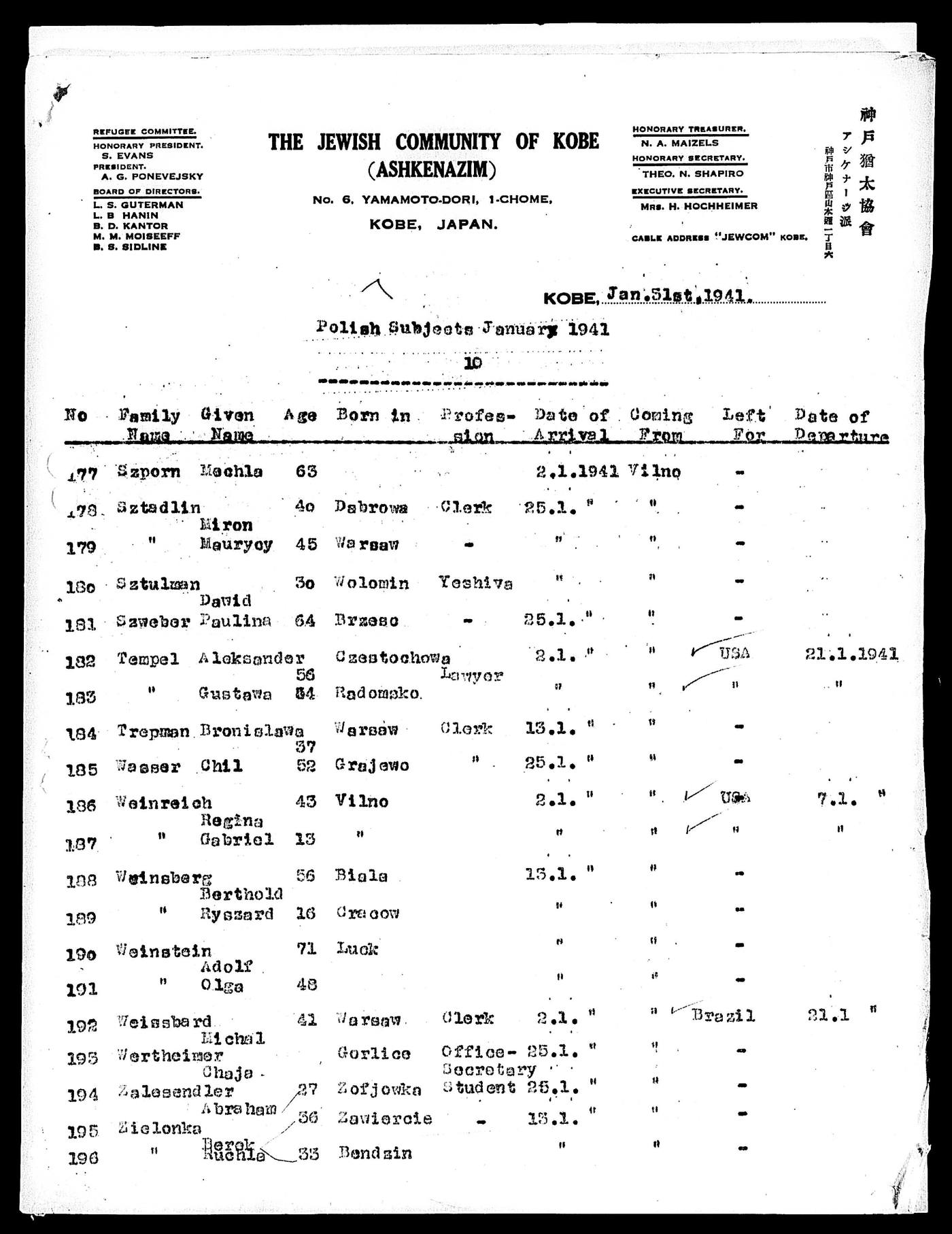
The 1940 Vilna refugee list has, at entry 6524, Berek Zielonka, born 1905 at Zawiercie, who had come from Sosnowiec; the year agrees with the register's compiled age, and Zawiercie agrees with what the archive already holds. - The JEWCOM register — the refugee register kept by the Refugee Committee of the Jewish Community of Kobe (Ashkenazim) at No. 6 Yamamoto-dori, 1-chome, whose cable address was 'JEWCOM Kobe'. Eighty-four pages on the committee's own printe…
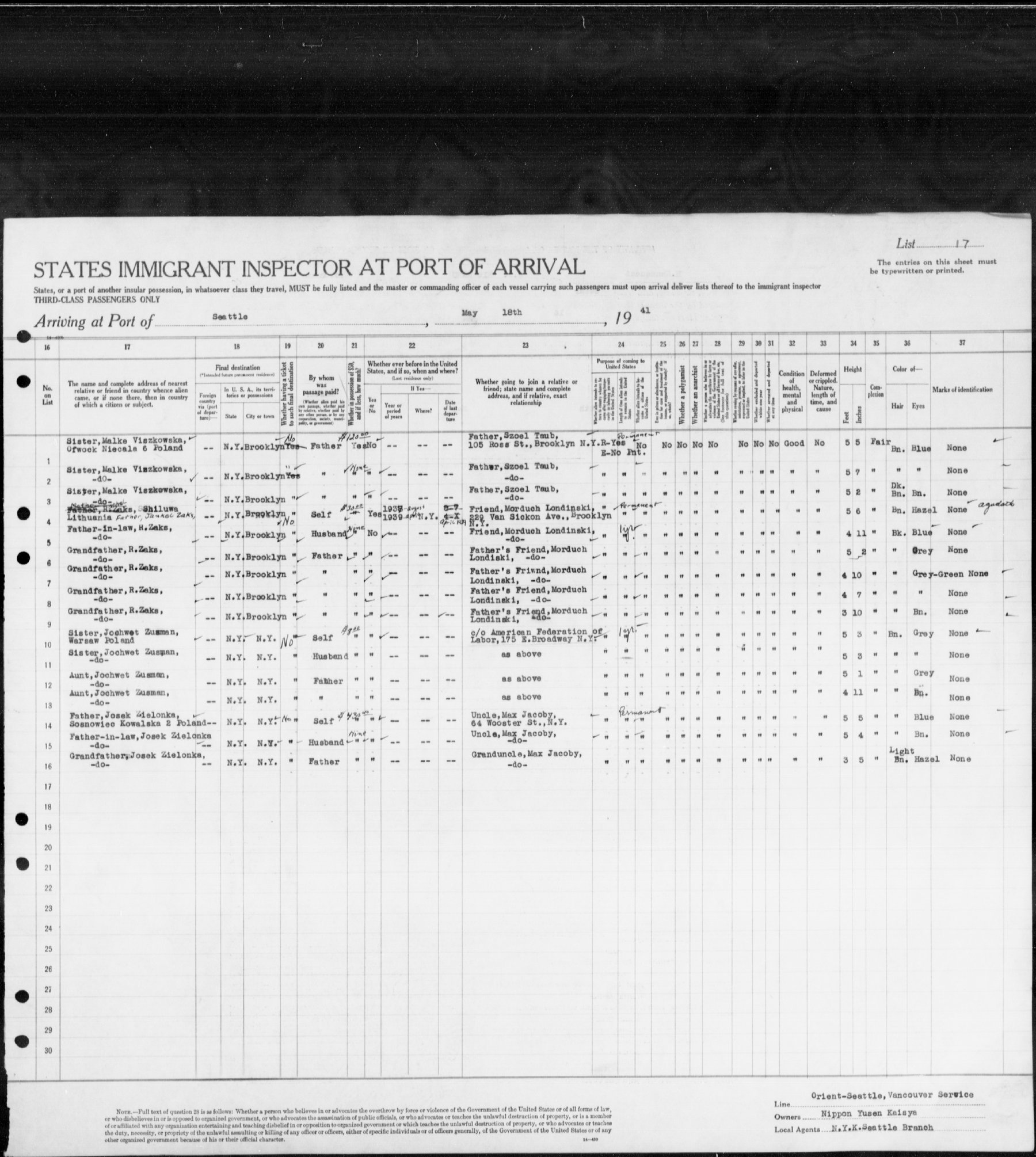
Entry 195 of the Kobe Jewish Community's refugee register: aged 56, born at Zawiercie, who arrived in Japan on 13 January 1941. - M.S. Hie Maru, Kobe 4 May – Yokohama 7 May – Seattle 18 May 1941, sheet 6 of 11 — transcribed for the Immigrant Ships Transcribers Guild by David Rosen
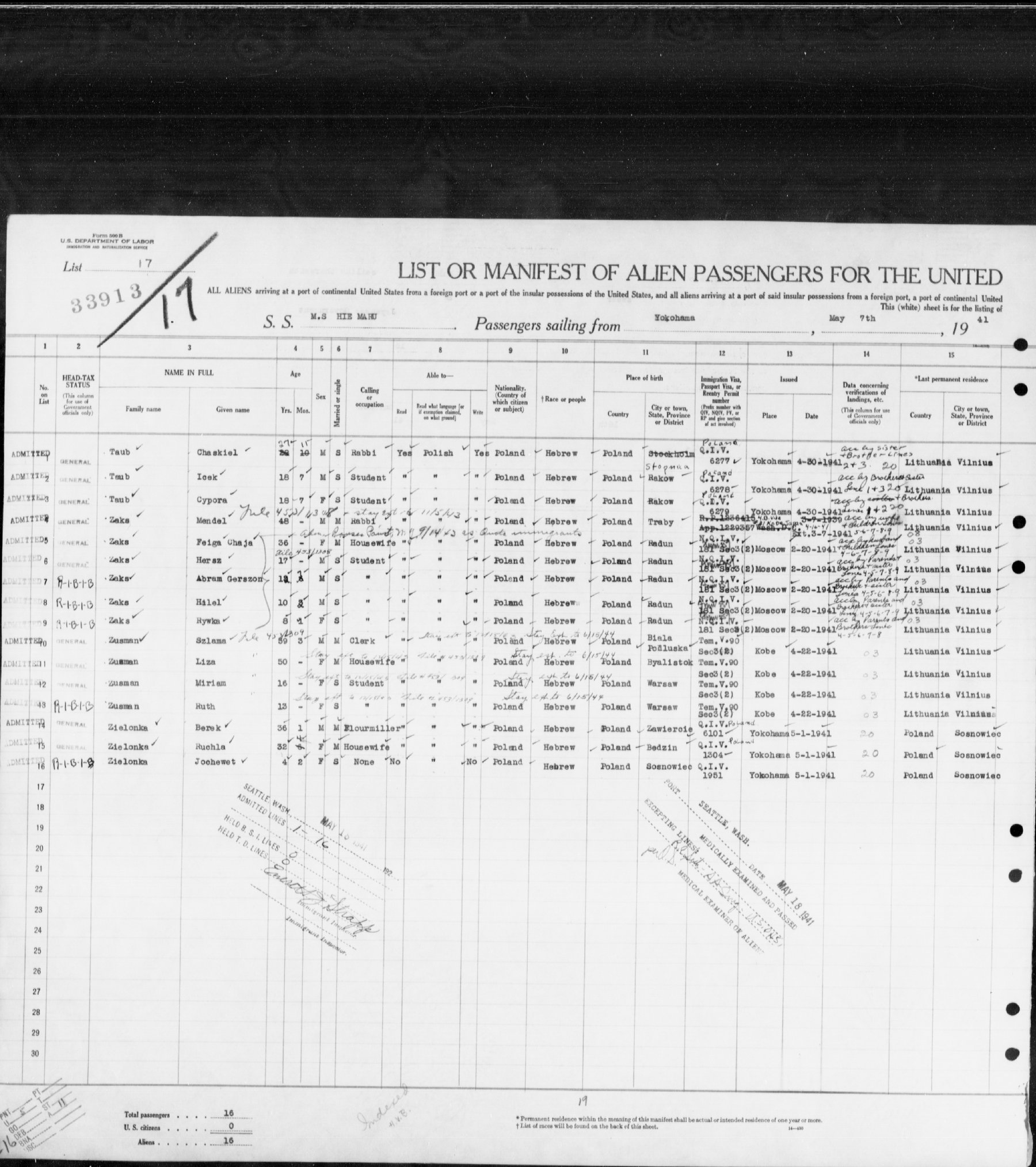
Hie Maru passenger no. 130; 36y 1m; Flourmiller; b. Zawiercie, Poland; last residence Sosnowiec, Poland; US visa Q.I.V.6101, issued Yokohama, 5-1-1941; to N.Y., N.Y.; joining Uncle, Max Jacoby, 64 Wooster St. N.Y.; nearest relative left behind: Father, Josek Zielonka, Sosnowiec Kowalska 2 Poland - M.S. Hie Maru, Kobe 4 May – Yokohama 7 May – Seattle 18 May 1941, sheet 6 of 11 — transcribed for the Immigrant Ships Transcribers Guild by David Rosen
Hie Maru passenger no. 132; 4y 2m; b. Sosnowiec, Poland; last residence Sosnowiec, Poland; US visa Q.I.V.1951, issued Yokohama, 5-1-1941; to N.Y., N.Y.; joining Granduncle, Max Jacoby, 64 Wooster St. N.Y.; nearest relative left behind: Grandfather, Josek Zielonka, Sosnowiec Kowalska 2 Poland; travelling with her parents Nos. 789 and 790; not separately on the register - "Washington, King, Seattle, Passenger Lists, 1890-1957", FamilySearch — index entry for Berek Zielonka, 1941: born about 1905, Poland. Digitised from NARA microfilm publication M1383 (passenger and crew lists of vessels arriving at Seatt…
FamilySearch's index of the Seattle passenger lists, read by the archive on 20 September 2026, has Berek Zielonka, born about 1905 in Poland, arriving at Seattle in 1941. The register's compiled line gives 1905, and the two agree. The name occurs once on the register, and a Polish-born passenger landing at Seattle in 1941 fits the route through Japan, so the entry is taken as this person's under the archive's rule of 19 September 2026 for records from the route. - Sam Zell - Wikipedia
- Leo Melamed: Escape to the Futures - Sugihara's Stand
- Leah Zell, "From Vilnius to Vladivostok Through the Needle's Eye" (Liberties Journal, 24 Jul 2026) — family photos Sosnowiec 1939 + the parents' Sugihara visa; the 1989 O'Hare meeting of her mother with Yukiko Sugihara
- The Passengers, arriving at Seattle in 1941: list or manifest of alien passengers, the sheet that names Chaskiel Taub — US National Archives, Record Group 85 (Immigration and Naturalization Service), Passenger and Crew Lists of Vessels A…
- Arriving at Seattle: the continuation sheet, with the relatives named and the destinations, for the sheet that names Chaskiel Taub — US National Archives, Record Group 85 (Immigration and Naturalization Service), Passenger and Crew Lists…